

sharon sanders
Editor-in-Chief & President
Shaken And (Hopefully) Stirred
# 4237
First, in case you missed it, a brief look at yesterday?s quake.
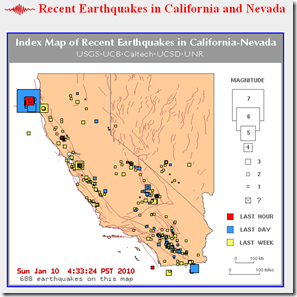
Yesterday?s quake (Large Blue box)
Of course, reviewing history doesn?t do us much good if we don?t learn from it. And the lesson here is to be prepared.
Two preparedness blogs, therefore, from this past summer.
For more information on preparedness, you can go to any of these reputable sites.
# 4237
Yesterday?s 6.5 quake off the Northern California coast wasn?t `the big one?, but it was a reminder that much of the world stands on shaky ground. And that for millions of people, the `big one? could come at any time.
Since this is as much a preparedness blog as it is a blog on emerging infectious disease, over the years I?ve written about earthquakes and preparedness a number of times.
One of the reasons is that, for many years, I lived atop the New Madrid fault in the Bootheel of Missouri. So earthquake issues are something I?ve dealt with personally.
Today, a review (with links) of some of my earlier quake and preparedness related blogs in the hopes that those who felt the quake in California will not only have been shaken . . . but stirred into preparing for the next one.
Since this is as much a preparedness blog as it is a blog on emerging infectious disease, over the years I?ve written about earthquakes and preparedness a number of times.
One of the reasons is that, for many years, I lived atop the New Madrid fault in the Bootheel of Missouri. So earthquake issues are something I?ve dealt with personally.
Today, a review (with links) of some of my earlier quake and preparedness related blogs in the hopes that those who felt the quake in California will not only have been shaken . . . but stirred into preparing for the next one.
First, in case you missed it, a brief look at yesterday?s quake.
Yesterday?s quake (Large Blue box)
6.5 quake shakes buildings on California coast
<cite>By TIM REITERMAN and GARANCE BURKE, Associated Press Writers </cite>
SAN FRANCISCO ? A powerful offshore earthquake rattled communities in far northern California, cutting power to thousands of customers, causing minor damage to homes and businesses and forcing many people to seek treatment for cuts and bruises from falling debris.
The 6.5 magnitude temblor hit at about 4:27 p.m. PST Saturday and was centered in the Pacific about 22 miles west of Ferndale, but was felt as far south as Capitola in central California and as far north as central Oregon, the U.S. Geological Survey said.
(Continue. . . )
From last May, a blog I wrote after a series of moderate quakes rumbled through the Los Angeles area. <cite>By TIM REITERMAN and GARANCE BURKE, Associated Press Writers </cite>
SAN FRANCISCO ? A powerful offshore earthquake rattled communities in far northern California, cutting power to thousands of customers, causing minor damage to homes and businesses and forcing many people to seek treatment for cuts and bruises from falling debris.
The 6.5 magnitude temblor hit at about 4:27 p.m. PST Saturday and was centered in the Pacific about 22 miles west of Ferndale, but was felt as far south as Capitola in central California and as far north as central Oregon, the U.S. Geological Survey said.
(Continue. . . )
Tuesday, May 19, 2009
Because It?s Always Earthquake Season
# 3225
For the second time in the past couple of days Los Angeles has been rattled by a 4+ temblor on the Richter Scale.
No damage was reported immediately following today?s 4.1 aftershock, but it does serve to remind us that many of us live on shaky ground.
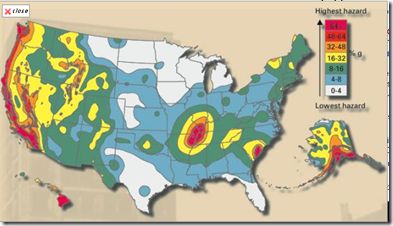
USGS map
As you can see by the map above, most of the United States is seismically active ? with Alaska, Hawaii, the west coast, and the mid-west seeing the most ? and strongest, quakes.
Few places, however, can claim to be completely immune to quakes.
Even in Florida, which is about as seismically quiet as it comes ? we?ve recorded a handful of quakes.
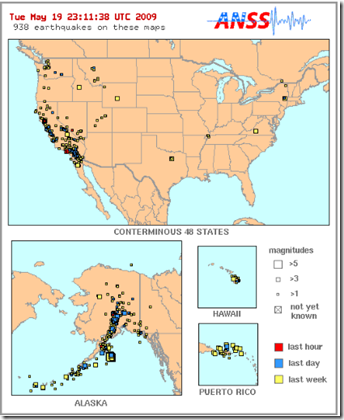
This map of seismic activity over the past 7 days shows most of the activity clustered in Alaska, California, and Hawaii.
But Texas, Missouri/Tennessee, Virginia and New York State also felt tremors.
While we can?t know when the next big earthquake will hit, or on what fault line it will strike, we do know that the earth is constantly shifting beneath our feet.
Tectonic pressures build, and spread, and at some point a quake occurs.
People who live in quake areas need not only to be prepared for a disaster, they need to take specific earthquake precautions as well.
(Continue . . .)
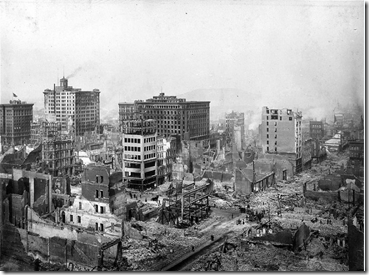
Last April (which was earthquake preparedness month), I wrote about the 103rd anniversary of the great San Francisco quake of 1906, and highlighted some new pictures recently released by the San Francisco Gate.Because It?s Always Earthquake Season
# 3225
For the second time in the past couple of days Los Angeles has been rattled by a 4+ temblor on the Richter Scale.
No damage was reported immediately following today?s 4.1 aftershock, but it does serve to remind us that many of us live on shaky ground.

USGS map
As you can see by the map above, most of the United States is seismically active ? with Alaska, Hawaii, the west coast, and the mid-west seeing the most ? and strongest, quakes.
Few places, however, can claim to be completely immune to quakes.
Even in Florida, which is about as seismically quiet as it comes ? we?ve recorded a handful of quakes.
This map of seismic activity over the past 7 days shows most of the activity clustered in Alaska, California, and Hawaii.
But Texas, Missouri/Tennessee, Virginia and New York State also felt tremors.
While we can?t know when the next big earthquake will hit, or on what fault line it will strike, we do know that the earth is constantly shifting beneath our feet.
Tectonic pressures build, and spread, and at some point a quake occurs.
People who live in quake areas need not only to be prepared for a disaster, they need to take specific earthquake precautions as well.
(Continue . . .)
Of course, reviewing history doesn?t do us much good if we don?t learn from it. And the lesson here is to be prepared.
Two preparedness blogs, therefore, from this past summer.
Tuesday, September 01, 2009
Red Cross Unveils `Do More Than Cross Your Fingers? Campaign
# 3691
September is National Preparedness month, and today, the American Red Cross kicks off their DO MORE THAN CROSS YOUR FINGERS campaign, with spokesperson Jamie Lee Curtis.
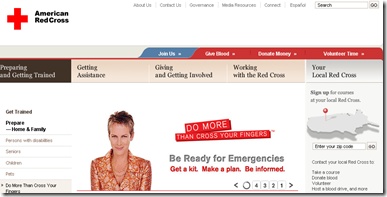
Preparedness, at the personal and community level, has always been a strong point in this blog. I took my first American Red Cross first aid training in the spring of 1972, and subsequently became an EMT, then a paramedic . . . and yes, a Red Cross CPR instructor along the way.
As a Floridian who has ridden through more than a few hurricanes, and a live-aboard boater (36 ft sailboat) for more than a decade in my younger years, I?m also a big believer in always being prepared.
The advice from the Red Cross to GET A KIT, MAKE A PLAN, and BE INFORMED is sage counsel.
Visit the DO MORE THAN CROSS YOUR FINGERS website, and begin today to prepare for you next emergency. It doesn?t have to be an earthquake, hurricane, or other natural disaster.
(Continue . . . )
And to finish up, a reminder that we should all be prepared to evacuate out of a high risk area at a moments notice. Red Cross Unveils `Do More Than Cross Your Fingers? Campaign
# 3691
September is National Preparedness month, and today, the American Red Cross kicks off their DO MORE THAN CROSS YOUR FINGERS campaign, with spokesperson Jamie Lee Curtis.
Preparedness, at the personal and community level, has always been a strong point in this blog. I took my first American Red Cross first aid training in the spring of 1972, and subsequently became an EMT, then a paramedic . . . and yes, a Red Cross CPR instructor along the way.
As a Floridian who has ridden through more than a few hurricanes, and a live-aboard boater (36 ft sailboat) for more than a decade in my younger years, I?m also a big believer in always being prepared.
The advice from the Red Cross to GET A KIT, MAKE A PLAN, and BE INFORMED is sage counsel.
Visit the DO MORE THAN CROSS YOUR FINGERS website, and begin today to prepare for you next emergency. It doesn?t have to be an earthquake, hurricane, or other natural disaster.
(Continue . . . )
Monday, August 17, 2009
What About BOB?
# 3635
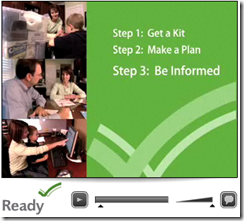
(Ready.gov 3 minute video)
It?s wildfire season out west, hurricane season along the Atlantic and Gulf Coasts and just about anywhere else floods, earthquakes, tornados, and all manner of other disasters could conspire to force you and your family from your home with very little notice.
Having an emergency `to go? kit or `BOB? is an important preparation, and could be lifesaving in an emergency.
(Continue . . . )
What About BOB?
# 3635
(Ready.gov 3 minute video)
It?s wildfire season out west, hurricane season along the Atlantic and Gulf Coasts and just about anywhere else floods, earthquakes, tornados, and all manner of other disasters could conspire to force you and your family from your home with very little notice.
Having an emergency `to go? kit or `BOB? is an important preparation, and could be lifesaving in an emergency.
(Continue . . . )
For more information on preparedness, you can go to any of these reputable sites.
FEMA http://www.fema.gov/index.shtm
AMERICAN RED CROSS http://www.redcross.org/
For Pandemic Preparedness Information: HHS Individual Planning Page
AMERICAN RED CROSS http://www.redcross.org/
For Pandemic Preparedness Information: HHS Individual Planning Page