
• FluTrackers.com Inc. does not provide medical advice. Information on this web site is collected from various internet resources, and the FluTrackers board of directors makes no warranty to the safety, efficacy, correctness or completeness of the information posted on this site by any author or poster. The information collated here is for instructional and/or discussion purposes only and is NOT intended to diagnose or treat any disease, illness, or other medical condition. Every individual reader or poster should seek advice from their personal physician/healthcare practitioner before considering or using any interventions that are discussed on this website. By continuing to access this website you agree to consult your personal physican before using any interventions posted on this website, and you agree to hold harmless FluTrackers.com Inc., the board of directors, the members, and all authors and posters for any effects from use of any medication, supplement, vitamin or other substance, device, intervention, etc. mentioned in posts on this website, or other internet venues referenced in posts on this website.
  • We are not asking for any donations. Do not donate to any entity who says they are raising funds for us.

_|USA: bird die-offs on two Minnesota lakes|_

Giuseppe

Emeritus
2008-07-22 19:09:27 - Biological Hazard - USA
EDIS CODE: BH-20080722-17677-USA
Date & Time: 2008-07-22 19:09:27 [UTC]
Area: USA, State of Minnesota, Minnesota Lake in Faribault County, Pigeon Lake in Meeker County,


Description:
The Department of Natural Resources is reporting bird die-offs on two Minnesota lakes.

Officials say dead and dying double-crested cormorants, pelicans, ring-billed gulls and a great blue heron were found last week at Minnesota Lake in Faribault County and Pigeon Lake in Meeker County.

DNR biologists say the dead birds included 687 cormorants and 37 pelicans.

DNR workers discovered the dead and dying birds while banding pelicans.

Initial tests for avian influenza were negative, but officials say the cause of the bird illness hasn't been determined yet.

The DNR, the U.S. Department of Agriculture and the U.S. Fish and Wildlife Service are cleaning up the sites and collecting more samples for lab analysis.

The name of Hazard: Bird Die-Off
Damage level: Moderate (Level 2)
Not confirmed information!
-
http://visz.rsoe.hu/alertmap/woalert_read.php?cid=17677&lang=eng
-------
 
Re: _|USA: bird die-offs on two Minnesota lakes|_

700+ Water Birds Found Dead in Minnesota Lakes
Cormorants, pelicans among birds dead in Se Minn. counties
Last Edited: Tuesday, 22 Jul 2008, 10:16 AM CDT
Created: Tuesday, 22 Jul 2008, 10:06 AM CDT

by Mike Durkin

LITCHFIELD, Minn. -- Hundreds of water birds, including American pelicans and double-crested cormorants, were found dead or dying in Minnesota lakes early last week.
Minnesota Department of Natural Resources workers were banding pelicans at Minnesota Lake in Faribault County and Pigeon Lake in Meeker County when they found the dead birds.

BIRD COUNT
The dead and dying birds were found on islands where egrets, gulls, herons and pelicans traditionally nest. As of Friday, 687 cormorants and 37 pelicans, three ring-billed gulls and one great blue heron had been found dead.
?We saw dead and dying adult cormorants, with the live ones unable to hold their heads up (at Pigeon Lake),? DNR wildlife biologist Jeff DiMatteo said. ?There were old carcasses that would suggest that it has been going on for at least a couple of weeks.?
The U.S. Fish and Wildlife Service in Litchfield is looking at sites near of both lakes for any other die-offs.

NO BIRD FLU
Initial tests for avian influenza were negative. The specific cause of the bird illness is still under investigation.
The Minnesota DNR, U.S. Department of Agriculture and U.S. Fish and Wildlife Service are conducting site clean-ups and collecting swab and carcass samples for lab analysis. Those lab results are expected later this week.

POULTRY PROBLEMS?
While the die-off so far has been detected only in wild water birds at the two locations, wild birds can be a potential source of disease when they come into contact with domestic poultry. For that reason, state animal health officials are reminding poultry farmers to monitor their flocks.

http://www.myfoxtwincities.com/myfo...n=4&locale=EN-US&layoutCode=TSTY&pageId=3.2.1
 
Re: _|USA: bird die-offs on two Minnesota lakes|_

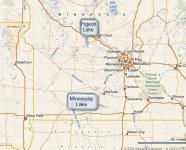
These two lakes are more than 100 miles from each other. See map.

minnesota pigeon lake 20080722 10-27-04 pm.jpg
 
Re: _|USA: bird die-offs on two Minnesota lakes|_

2007 had large die-off of similar birds in Minnesota.
Mortality is the red figure.
Data from http://www.nwhc.usgs.gov/publications/quarterly_reports/2007_qtr_3.jsp

-----------------------------------------------------------------------

<TABLE id=report cellSpacing=0 cellPadding=3 width="100%" border=0><TBODY><TR><TD>MN</TD><TD>Lac qui Parle State Park</TD><TD>06/15/07-09/15/07</TD><TD>American White Pelican, Ring-Billed Gull, Double-Crested Cormorant, Unidentified Goose, Mallard</TD><TD>3,850 (e)</TD><TD>Botulism type C, Newcastle Disease Virus, Open</TD><TD>NW</TD></TR><TR><TD>MN</TD><TD>Cass County</TD><TD>09/01/07-09/27/07</TD><TD>Ring-Billed Gull, Double-Crested Cormorant, Herring Gull, Caspian Tern, American White Pelican

.
</TD><TD>400 (e)</TD><TD>Avian Cholera, Newcastle Disease Virus</TD></TR></TBODY></TABLE>
 
Back
Top