Laidback Al
Well-known member
A Summary of Worldwide Human H5N1 Cases in 2011
Laidback Al, Senior Moderator, www.FluTrackers.com
January 1, 2012
Abstract ? In 2011, 59 human cases of H5N1 were reported from around the world, a 23% increase over 2010. Five countries reported cases in 2011, Bangladesh, Cambodia, China, Egypt, and Indonesia. Almost half of the 59 cases (about 45%) were children under 10 years old. The fatality rate did not appreciably decline in 2011, about half of all the reported cases died. Four small family clusters were noted during the year. The source of exposure for all of the cluster cases has been reported as exposure to sick and dying poultry. None of these clusters resulted in sustained human to human transmission. Based on an analysis of the 2011 data, the potential for a virulent H5N1 pandemic has not diminished.
The big H5N1 news of 2011 was the bioethical debate surrounding the publication of the details of genetic research by two groups of scientists who were able to create a laboratory strain of H5N1 that maintained it virulence and was easily transmissible in aerosolized droplets. A few of the many media reports and commentaries are referenced in this FluTrackers thread. Equally as important, but without the accompanying media hype, is that there was a 23% increase in the number of worldwide H5N1 human cases over the number of cases in 2010. In 2011, at least 59 cases were recorded; in 2010 the total was only 48. The following summary of human cases from 2011 is generally organized according to the outlined presented last year in ?A Summary of Human H5N1 Cases in 2010? (link).
Background
Influenza A(H5N1) (often referred to ?bird flu? or avian influenza or HPAI) is a novel influenza virus. It first infected humans in Hong Kong in 1997, where 19 human cases were discovered over a period of several months. Most of the cases were infected from sick poultry, although one family cluster was noted. An extensive culling campaign was instituted and over 1.5 million poultry were eradicated in Hong Kong. No more human infections were discovered after the culling that year.
About 2002, avian influenza became an internationally reportable disease to the World Health Organization (WHO) under International Health Regulations (IHR). I believe the first WHO Disease Outbreak News report for human H5N1 cases was published in February of 2003 which reported several H5N1 infected family members from Hong Kong who travelled to Fujian Province where they were most likely infected. Three family members died. (initial link)
Since 2003 until December 31, 2011, the World Health Organization (WHO) has officially reported a total of 574 confirmed human cases of H5N1, 58 of these in 2011. The most recent WHO time line of significant events associated with the H5N1 virus was updated on November 7, 2011 (link).
The recent human case reported from Shenzhen, China (see this thread), has not yet been reported by WHO, but will be included in the 2011 count because onset was on December 21, 2011. This individual is included in the tallies and discussions below.
Number of Human H5N1 Cases in 2011
The tabulation for WHO-confirmed H5N1 cases in 2011 is 58, including the December-reported case from Egypt (link and link), but will most likely include the recent case from China (link) bringing the total to at least 59 in 2011. Compared to 2010, the number of worldwide H5N1 cases increased in 2011 by 23% (11 cases).
Since 2003, 15 countries from around the world have reported human H5N1 cases to WHO. In 2011, only 5 countries will have reported human cases of H5N1, Bangladesh, Cambodia, China, Egypt, and Indonesia. Each of these countries has previously reported human cases. Vietnam, which has reported a few cases each year between 2007 and 2010, did not report any cases in 2011.
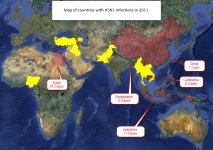
Map of countries with H5N1 infections in 2011. Yellow highlighted countries have previously reported human H5N1 cases in prior years, but not in 2011.
Last year (2010), Egypt led the world?s countries with 29 confirmed H5N1 cases that year. This year, Egypt again leads with 37 cases. Indonesia is next with 11 cases, followed by Cambodia (8 cases), Bangladesh (2 cases), and China (1 cases). Prior to 2011, Cambodia had only reported 10 cases between 2005 and 2010, the 8 cases from 2011 represent a surge in cases in this country.
With 182 WHO reported cases, Indonesia continues to lead the world in cumulative number of human H5N1 cases. With the 37 newly reported cases in 2011, Egypt?s total number of cases is 156 and second only to Indonesia. Every year since 2009 Egypt has annually outpaced Indonesia in the number of officially reported H5N1 cases. At the current rate, Egypt will surpass Indonesia as the country with the most confirmed H5N1 infections some time in 2012.
H5N1 Case-Fatality Rate in 2011
Of the 59 cases in 2011, 32 died. The overall case-fatality rate (CFR) for H5N1 in 2011 was 54%, very similar to 2010 when the overall CFR was 50%. The highest CFR in 2011 was 100% for Cambodia, all 8 confirmed cases died and China - one case, one death. The lowest was Bangladesh at 0%, neither of the two cases from this country died.
Only six of the fifteen countries with human cases of H5N1 have 15 or more officially reported cases. For each of these six countries the cumulative CFR is, in descending order, 88% for Cambodia, followed by 82% for Indonesia, 68% for Thailand, 65% for China, 49% for Vietnam, and the country with the lowest CFR is Egypt at 36%. Together these six countries through 2011 have an overall CFR of 60%. The interesting statistic is that the CFR in Egypt dropped from 44% in 2010 to 36% in 2011. Although there is inter-year variability, the overall CFR for the 574 WHO reported cases is 59%.
Based on data available in 2007, some researchers have estimated that the real CFR for H5N1 should be between 14% and 33% (link). The authors of the study write ?Clearly, if such a CF rate were to be sustained in a pandemic, H5N1 would present a truly dreadful scenario. A concerted and dedicated effort by the international community to avert a pandemic through combating avian influenza in animals and humans in affected countries needs to be a global priority.? In light of the additional data since 2007 (including the more recent WHO reports) and the discussion of CFR above, there is no compelling reason to believe that the CFR for the H5N1 viruses should range between 14% and 33%.
Demographics of H5N1 Cases in 2011
For the 59 H5N1 cases from 2011 some limited demographic information is available in the WHO Disease Outbreak News. Also local media reports sometimes have additional demographic information that is presented in translated news reports here at FluTrackers and elsewhere.
Last year in 2010, the ratio of infections between males and females was highly skewed. About 33% of the cases were male while about 67% were females in 2010. In 2011, females still outpaced males, although at a lesser rate. Females represented about 59% of 2011 cases while males represented only 41% of the cases. Presumably the same factors that skew the sex ratio in regular influenza apply to H5N1 cases. A recent article, Mechanisms of sex disparities in influenza pathogenesis[FONT="],[/FONT] suggests that females generate higher proinflammatory cytokine and chemokine responses to influenza resulting in greater morbidity and mortality than males. The authors also note that pregnancy is a risk factor for greater morbidity and mortality. Since 2007 there have been at least six pregnant women that have contracted H5N1. None survived.
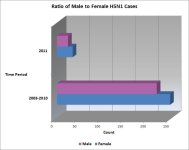
Chart of Male/Female ratio of H5N1 infections, 2011 and 2003-2010
The ages of H5N1 cases from 2011 range from less than 1 to 55 years old, with a median age of 11. The median age of infection in 2011 is much lower than in 2010, although not as low as in 2009 when numerous H5N1 infections in children in Egypt lowered the median age to 4 years.
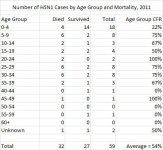
Table of 2011 H5N1 infections by age group.
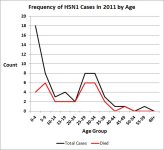
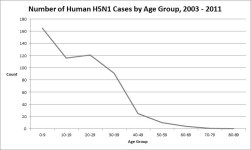
Graph of the Number of 2011 H5N1 cases by age group.
The table and graph above show that children under 4 years represent about 31% of all H5N1 infections in 2011. Notably, the CFR for this youngest age group was only 22%. Why a such a high percentage of these children are surviving is unclear, but it may reflect that concerned parents are taking their sick children to the hospital early after symptom onset and that early administration of antivirals were effective in saving the lives of some of these children.
H5N1 Clusters in 2011
In 2011 four human cluster of H5N1 were reported. In February a mother and son contracted H5N1 in Cambodia, both died. Also, in February, a mother and daughter from Bekasi in Indonesia became infected. The mother died and apparently the child survived. In September three family members, a mother and two children, contracted H5N1 on the island of Bali, Indonesia. None survived. Finally, In November, an adult brother and sister were infected, along with the woman?s child in Menyet El-Nasr, Egypt. Only the child survived. For all of these individuals, the reports suggest that these infections were the result of exposure to a common source, most likely poultry. No evidence of human-to-human transmission was reported.
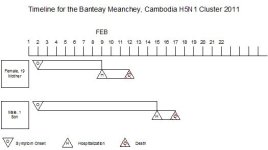
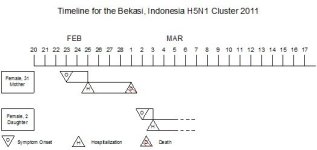
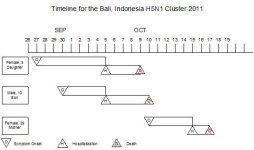
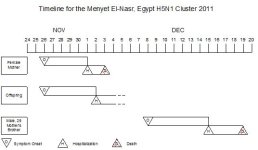
Timeline for each of the four H5N1 cluster in 2011.
Although not a 2011 human cluster, media reports in Indonesia in 2011 retrospectively reported a three person family cluster in 2009 (link). In 2009 Indonesia balked at IHR and failed to report H5N1 cases throughout the year. Indonesia reported 20 H5N1 cases on December 28, 2009 (link). Because WHO did not received any case-specific information on these individuals, these cases could only be counted in the aggregate for 2009. Throughout 2010, WHO provided a footnote, noting that these 20 cases were counted into the aggregate for Indonesia. In 2011, WHO cumulative tables no longer included this footnote. Also in 2011, WHO no longer provides the archives of the previous cumulative count-by-countries-by-year tables. To obtain the previous archive tables one must request them from WHO (?earlier tables are available upon request at WHOinfluenza@who.int?).
H5N1 Seasonality
Recently the authors of Seasonal Oscillation of Human Infection with Influenza A/H5N1 in Egypt and Indonesia state ?despite recent suggestions that H5N1 incidence in humans is seasonal with more cases occurring in cooler months, evidence for these claims has not been critically evaluated?. The authors of the study only found a weak correlation between weather and climate events and H5N1 infections in Egypt and Indonesia. The authors also state ?Seasonality of human H5N1 was observed but not statistically significant in Egypt, while in Indonesia H5N1 incidence did not correlate with changes in meteorological variables. Therefore, it remains possible that the observed correlation between weather and human H5N1 in Egypt can be explained by chance.?
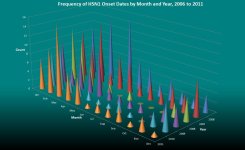
Previously researchers have documented that H5N1 infections follow a seasonal infection pattern consistent with regular influenza infection patterns. The failure of these authors to find a seasonal pattern is probably a function of an inadequate sample of data. The graph below shows the incidence of onset for H5N1 cases by month from all countries between 2006 and 2011. Clearly, the number of H5N1 infections increases between December and May worldwide every year. Additional research is necessary to understand the mechanics of seasonal fluctuation of H5N1 infections.
H5N1 Sequences
Last year Egypt released sequences from 14 H5N1 cases. This year, even though Egypt has reported the largest number of H5N1 cases (37) not one sequence has been publicly released. In contrast sequences for five of the eight infected individuals from Cambodia have been released.
DISCUSSION ISSUES
How Representative is the WHO Data on H5N1 Cases?
As noted last year and is still true this year, there is no framework to assess how representative these 59 cases are of the full range of human H5N1 infections that occurred throughout the world in 2011. The biases in the data could result from any number of factors, poor surveillance and case identification, inadequate reporting, economic expediency, political motivations, etc.
The biggest concern about data biases relates to the possibility that there are many cases of mild or subclinical infections. In one recent article Identification of H5N1-Specific T-Cell Responses in a High-risk Cohort in Vietnam Indicates the Existence of Potential Asymptomatic Infections, the authors found that 4 of 747 individual had antibodies to H5N1 and 24 of the 747 had H5-Specific T-cell responses suggesting there are asymptomatic cases of H5N1. These researchers studied a high risk population in Vietnam so it is not known if these results can be extrapolated to the larger general population. It should be a research priority to identify the parameters of mild or asymptomatic H5N1 cases.
Call For Open Access of Infectious Disease Data
The information presented here was derived from a number of public on line sources. However, there is no open source, publically available database human H5N1 cases. A preliminary line list was developed by the authors of Avian influenza A(H5N1) in humans: new insights from a line list of World Health Organization confirmed cases, September 2006 to August 2010 and is available in a spread sheet format (link). Echoing these authors, FluTrackers has made a Call for Open Data on All Influenza, Human & Animal, from Around the World
High H5N1 Infection Rates Among Small Children
Since 2009, there has been an observable trend of an increasing number of H5N1 infections among very young children. This should not be surprising since H5N1 is a novel influenza virus, and young children are more susceptible to influenza viruses in general. What is surprising is the recovery rate ( i.e. low CFR) for this age group. As virulent at H5N1 is, many of the infected children survive. The children survive at a much higher rate than their infected adult counterparts. These children would not have time to build up cross-protective immunity, so the recovery process for these young people is worthy of further study. Also, most of these child infections do not occur in family clusters so questions arise about the exposure source for these children. What is the nature of contact between exposed poultry and these young children? Is there a mild asymptomatic strain of H5N1 circulating in some countries?
Probability of an H5N1 Pandemic
While the limited epidemiological data on 570+ cases of H5N1 infections cannot help predict the potential of a virulent H5N1 pandemic, recent research by two teams, one in the Netherlands and one at the University of Wisconsin, might shed some light on this important issue (see this FluTrackers thread). The research results demonstrated a ?proof of concept?. The researchers created a virulent and transmissible strain of the H5N1 influenza virus that can infect through aerosolized respiratory droplets. These experiments provide strong evidence that H5N1 has the potential to become a pandemic virus strain without losing its virulence.
While the details of the experiments have not yet been released, media reports and researcher interviews indicate that only a limited number of genetic changes were necessary to create this virulent strain. For virologists and genetic researchers with a background in statistics, I think it would be a trivial exercise to develop a probability estimate of how likely such genetic changes can occur in Nature without human intervention. While the threat of a release of a laboratory created virulent H5N1 strain is very real, we must not lose sight of the potential for such a strain to reassort or mutate in Nature and start the next high CFR pandemic.
Concluding Comments
Based on the comments from the researchers at the Erasmus Center in the Netherlands, the researchers from the University and Wisconsin, and other noted influenza researchers, a high fatality H5N1 pandemic scenario is a much more likely event today than it was this time last year. So, once more it is necessary to call on governments from around the world to develop comprehensive plans for managing serious infectious disease threats. There is a need for additional research and planning, not just for a potential H5N1 pandemic, but for any novel emerging infectious disease that could cause a serious pandemic.
Notes
1: The data used in this post have been derived from numerous publicly available online sources including WHO, various ministries of health reports, and other internet media reports. For some individual cases details such as age, sex, specific residence, etc. are lacking. Also news media reports sometime provide conflicting data about individual cases. The basic data and information presented here is believed to be reasonably accurate.
2: The information presented here is based on data reported through December 31, 2011. A review of the WHO GAR announcements shows that some H5N1 cases are only reported and confirmed weeks and sometimes months later. Because WHO uses the date of onset to assign a case to particular year, there could be some cases that will be retrospectively assigned to 2011 at a later date which will affect the data presented here.
Acknowledgements and Disclaimer
I would like to thank all of the posters and moderators at FluTrackers.com, internet bloggers, and other internet forum members for their efforts at online tracking of H5N1 and other emerging infectious diseases. Thanks are also due to open source journals and researchers who post full copies of their papers. The opinions expressed here are my own and do not necessarily represent those of FluTrackers.com.
Laidback Al, Senior Moderator, www.FluTrackers.com
January 1, 2012
Abstract ? In 2011, 59 human cases of H5N1 were reported from around the world, a 23% increase over 2010. Five countries reported cases in 2011, Bangladesh, Cambodia, China, Egypt, and Indonesia. Almost half of the 59 cases (about 45%) were children under 10 years old. The fatality rate did not appreciably decline in 2011, about half of all the reported cases died. Four small family clusters were noted during the year. The source of exposure for all of the cluster cases has been reported as exposure to sick and dying poultry. None of these clusters resulted in sustained human to human transmission. Based on an analysis of the 2011 data, the potential for a virulent H5N1 pandemic has not diminished.
The big H5N1 news of 2011 was the bioethical debate surrounding the publication of the details of genetic research by two groups of scientists who were able to create a laboratory strain of H5N1 that maintained it virulence and was easily transmissible in aerosolized droplets. A few of the many media reports and commentaries are referenced in this FluTrackers thread. Equally as important, but without the accompanying media hype, is that there was a 23% increase in the number of worldwide H5N1 human cases over the number of cases in 2010. In 2011, at least 59 cases were recorded; in 2010 the total was only 48. The following summary of human cases from 2011 is generally organized according to the outlined presented last year in ?A Summary of Human H5N1 Cases in 2010? (link).
Background
Influenza A(H5N1) (often referred to ?bird flu? or avian influenza or HPAI) is a novel influenza virus. It first infected humans in Hong Kong in 1997, where 19 human cases were discovered over a period of several months. Most of the cases were infected from sick poultry, although one family cluster was noted. An extensive culling campaign was instituted and over 1.5 million poultry were eradicated in Hong Kong. No more human infections were discovered after the culling that year.
About 2002, avian influenza became an internationally reportable disease to the World Health Organization (WHO) under International Health Regulations (IHR). I believe the first WHO Disease Outbreak News report for human H5N1 cases was published in February of 2003 which reported several H5N1 infected family members from Hong Kong who travelled to Fujian Province where they were most likely infected. Three family members died. (initial link)
Since 2003 until December 31, 2011, the World Health Organization (WHO) has officially reported a total of 574 confirmed human cases of H5N1, 58 of these in 2011. The most recent WHO time line of significant events associated with the H5N1 virus was updated on November 7, 2011 (link).
The recent human case reported from Shenzhen, China (see this thread), has not yet been reported by WHO, but will be included in the 2011 count because onset was on December 21, 2011. This individual is included in the tallies and discussions below.
Number of Human H5N1 Cases in 2011
The tabulation for WHO-confirmed H5N1 cases in 2011 is 58, including the December-reported case from Egypt (link and link), but will most likely include the recent case from China (link) bringing the total to at least 59 in 2011. Compared to 2010, the number of worldwide H5N1 cases increased in 2011 by 23% (11 cases).
Since 2003, 15 countries from around the world have reported human H5N1 cases to WHO. In 2011, only 5 countries will have reported human cases of H5N1, Bangladesh, Cambodia, China, Egypt, and Indonesia. Each of these countries has previously reported human cases. Vietnam, which has reported a few cases each year between 2007 and 2010, did not report any cases in 2011.
Map of countries with H5N1 infections in 2011. Yellow highlighted countries have previously reported human H5N1 cases in prior years, but not in 2011.
Last year (2010), Egypt led the world?s countries with 29 confirmed H5N1 cases that year. This year, Egypt again leads with 37 cases. Indonesia is next with 11 cases, followed by Cambodia (8 cases), Bangladesh (2 cases), and China (1 cases). Prior to 2011, Cambodia had only reported 10 cases between 2005 and 2010, the 8 cases from 2011 represent a surge in cases in this country.
With 182 WHO reported cases, Indonesia continues to lead the world in cumulative number of human H5N1 cases. With the 37 newly reported cases in 2011, Egypt?s total number of cases is 156 and second only to Indonesia. Every year since 2009 Egypt has annually outpaced Indonesia in the number of officially reported H5N1 cases. At the current rate, Egypt will surpass Indonesia as the country with the most confirmed H5N1 infections some time in 2012.
H5N1 Case-Fatality Rate in 2011
Of the 59 cases in 2011, 32 died. The overall case-fatality rate (CFR) for H5N1 in 2011 was 54%, very similar to 2010 when the overall CFR was 50%. The highest CFR in 2011 was 100% for Cambodia, all 8 confirmed cases died and China - one case, one death. The lowest was Bangladesh at 0%, neither of the two cases from this country died.
Only six of the fifteen countries with human cases of H5N1 have 15 or more officially reported cases. For each of these six countries the cumulative CFR is, in descending order, 88% for Cambodia, followed by 82% for Indonesia, 68% for Thailand, 65% for China, 49% for Vietnam, and the country with the lowest CFR is Egypt at 36%. Together these six countries through 2011 have an overall CFR of 60%. The interesting statistic is that the CFR in Egypt dropped from 44% in 2010 to 36% in 2011. Although there is inter-year variability, the overall CFR for the 574 WHO reported cases is 59%.
Based on data available in 2007, some researchers have estimated that the real CFR for H5N1 should be between 14% and 33% (link). The authors of the study write ?Clearly, if such a CF rate were to be sustained in a pandemic, H5N1 would present a truly dreadful scenario. A concerted and dedicated effort by the international community to avert a pandemic through combating avian influenza in animals and humans in affected countries needs to be a global priority.? In light of the additional data since 2007 (including the more recent WHO reports) and the discussion of CFR above, there is no compelling reason to believe that the CFR for the H5N1 viruses should range between 14% and 33%.
Demographics of H5N1 Cases in 2011
For the 59 H5N1 cases from 2011 some limited demographic information is available in the WHO Disease Outbreak News. Also local media reports sometimes have additional demographic information that is presented in translated news reports here at FluTrackers and elsewhere.
Last year in 2010, the ratio of infections between males and females was highly skewed. About 33% of the cases were male while about 67% were females in 2010. In 2011, females still outpaced males, although at a lesser rate. Females represented about 59% of 2011 cases while males represented only 41% of the cases. Presumably the same factors that skew the sex ratio in regular influenza apply to H5N1 cases. A recent article, Mechanisms of sex disparities in influenza pathogenesis[FONT="],[/FONT] suggests that females generate higher proinflammatory cytokine and chemokine responses to influenza resulting in greater morbidity and mortality than males. The authors also note that pregnancy is a risk factor for greater morbidity and mortality. Since 2007 there have been at least six pregnant women that have contracted H5N1. None survived.
Chart of Male/Female ratio of H5N1 infections, 2011 and 2003-2010
The ages of H5N1 cases from 2011 range from less than 1 to 55 years old, with a median age of 11. The median age of infection in 2011 is much lower than in 2010, although not as low as in 2009 when numerous H5N1 infections in children in Egypt lowered the median age to 4 years.
Table of 2011 H5N1 infections by age group.
Graph of the Number of 2011 H5N1 cases by age group.
The table and graph above show that children under 4 years represent about 31% of all H5N1 infections in 2011. Notably, the CFR for this youngest age group was only 22%. Why a such a high percentage of these children are surviving is unclear, but it may reflect that concerned parents are taking their sick children to the hospital early after symptom onset and that early administration of antivirals were effective in saving the lives of some of these children.
H5N1 Clusters in 2011
In 2011 four human cluster of H5N1 were reported. In February a mother and son contracted H5N1 in Cambodia, both died. Also, in February, a mother and daughter from Bekasi in Indonesia became infected. The mother died and apparently the child survived. In September three family members, a mother and two children, contracted H5N1 on the island of Bali, Indonesia. None survived. Finally, In November, an adult brother and sister were infected, along with the woman?s child in Menyet El-Nasr, Egypt. Only the child survived. For all of these individuals, the reports suggest that these infections were the result of exposure to a common source, most likely poultry. No evidence of human-to-human transmission was reported.
Timeline for each of the four H5N1 cluster in 2011.
Although not a 2011 human cluster, media reports in Indonesia in 2011 retrospectively reported a three person family cluster in 2009 (link). In 2009 Indonesia balked at IHR and failed to report H5N1 cases throughout the year. Indonesia reported 20 H5N1 cases on December 28, 2009 (link). Because WHO did not received any case-specific information on these individuals, these cases could only be counted in the aggregate for 2009. Throughout 2010, WHO provided a footnote, noting that these 20 cases were counted into the aggregate for Indonesia. In 2011, WHO cumulative tables no longer included this footnote. Also in 2011, WHO no longer provides the archives of the previous cumulative count-by-countries-by-year tables. To obtain the previous archive tables one must request them from WHO (?earlier tables are available upon request at WHOinfluenza@who.int?).
H5N1 Seasonality
Recently the authors of Seasonal Oscillation of Human Infection with Influenza A/H5N1 in Egypt and Indonesia state ?despite recent suggestions that H5N1 incidence in humans is seasonal with more cases occurring in cooler months, evidence for these claims has not been critically evaluated?. The authors of the study only found a weak correlation between weather and climate events and H5N1 infections in Egypt and Indonesia. The authors also state ?Seasonality of human H5N1 was observed but not statistically significant in Egypt, while in Indonesia H5N1 incidence did not correlate with changes in meteorological variables. Therefore, it remains possible that the observed correlation between weather and human H5N1 in Egypt can be explained by chance.?
Previously researchers have documented that H5N1 infections follow a seasonal infection pattern consistent with regular influenza infection patterns. The failure of these authors to find a seasonal pattern is probably a function of an inadequate sample of data. The graph below shows the incidence of onset for H5N1 cases by month from all countries between 2006 and 2011. Clearly, the number of H5N1 infections increases between December and May worldwide every year. Additional research is necessary to understand the mechanics of seasonal fluctuation of H5N1 infections.
H5N1 Sequences
Last year Egypt released sequences from 14 H5N1 cases. This year, even though Egypt has reported the largest number of H5N1 cases (37) not one sequence has been publicly released. In contrast sequences for five of the eight infected individuals from Cambodia have been released.
DISCUSSION ISSUES
How Representative is the WHO Data on H5N1 Cases?
As noted last year and is still true this year, there is no framework to assess how representative these 59 cases are of the full range of human H5N1 infections that occurred throughout the world in 2011. The biases in the data could result from any number of factors, poor surveillance and case identification, inadequate reporting, economic expediency, political motivations, etc.
The biggest concern about data biases relates to the possibility that there are many cases of mild or subclinical infections. In one recent article Identification of H5N1-Specific T-Cell Responses in a High-risk Cohort in Vietnam Indicates the Existence of Potential Asymptomatic Infections, the authors found that 4 of 747 individual had antibodies to H5N1 and 24 of the 747 had H5-Specific T-cell responses suggesting there are asymptomatic cases of H5N1. These researchers studied a high risk population in Vietnam so it is not known if these results can be extrapolated to the larger general population. It should be a research priority to identify the parameters of mild or asymptomatic H5N1 cases.
Call For Open Access of Infectious Disease Data
The information presented here was derived from a number of public on line sources. However, there is no open source, publically available database human H5N1 cases. A preliminary line list was developed by the authors of Avian influenza A(H5N1) in humans: new insights from a line list of World Health Organization confirmed cases, September 2006 to August 2010 and is available in a spread sheet format (link). Echoing these authors, FluTrackers has made a Call for Open Data on All Influenza, Human & Animal, from Around the World
High H5N1 Infection Rates Among Small Children
Since 2009, there has been an observable trend of an increasing number of H5N1 infections among very young children. This should not be surprising since H5N1 is a novel influenza virus, and young children are more susceptible to influenza viruses in general. What is surprising is the recovery rate ( i.e. low CFR) for this age group. As virulent at H5N1 is, many of the infected children survive. The children survive at a much higher rate than their infected adult counterparts. These children would not have time to build up cross-protective immunity, so the recovery process for these young people is worthy of further study. Also, most of these child infections do not occur in family clusters so questions arise about the exposure source for these children. What is the nature of contact between exposed poultry and these young children? Is there a mild asymptomatic strain of H5N1 circulating in some countries?
Probability of an H5N1 Pandemic
While the limited epidemiological data on 570+ cases of H5N1 infections cannot help predict the potential of a virulent H5N1 pandemic, recent research by two teams, one in the Netherlands and one at the University of Wisconsin, might shed some light on this important issue (see this FluTrackers thread). The research results demonstrated a ?proof of concept?. The researchers created a virulent and transmissible strain of the H5N1 influenza virus that can infect through aerosolized respiratory droplets. These experiments provide strong evidence that H5N1 has the potential to become a pandemic virus strain without losing its virulence.
While the details of the experiments have not yet been released, media reports and researcher interviews indicate that only a limited number of genetic changes were necessary to create this virulent strain. For virologists and genetic researchers with a background in statistics, I think it would be a trivial exercise to develop a probability estimate of how likely such genetic changes can occur in Nature without human intervention. While the threat of a release of a laboratory created virulent H5N1 strain is very real, we must not lose sight of the potential for such a strain to reassort or mutate in Nature and start the next high CFR pandemic.
Concluding Comments
Based on the comments from the researchers at the Erasmus Center in the Netherlands, the researchers from the University and Wisconsin, and other noted influenza researchers, a high fatality H5N1 pandemic scenario is a much more likely event today than it was this time last year. So, once more it is necessary to call on governments from around the world to develop comprehensive plans for managing serious infectious disease threats. There is a need for additional research and planning, not just for a potential H5N1 pandemic, but for any novel emerging infectious disease that could cause a serious pandemic.
Notes
1: The data used in this post have been derived from numerous publicly available online sources including WHO, various ministries of health reports, and other internet media reports. For some individual cases details such as age, sex, specific residence, etc. are lacking. Also news media reports sometime provide conflicting data about individual cases. The basic data and information presented here is believed to be reasonably accurate.
2: The information presented here is based on data reported through December 31, 2011. A review of the WHO GAR announcements shows that some H5N1 cases are only reported and confirmed weeks and sometimes months later. Because WHO uses the date of onset to assign a case to particular year, there could be some cases that will be retrospectively assigned to 2011 at a later date which will affect the data presented here.
Acknowledgements and Disclaimer
I would like to thank all of the posters and moderators at FluTrackers.com, internet bloggers, and other internet forum members for their efforts at online tracking of H5N1 and other emerging infectious diseases. Thanks are also due to open source journals and researchers who post full copies of their papers. The opinions expressed here are my own and do not necessarily represent those of FluTrackers.com.
Last edited: