• FluTrackers.com Inc. does not provide medical advice. Information on this web site is collected from various internet resources, and the FluTrackers board of directors makes no warranty to the safety, efficacy, correctness or completeness of the information posted on this site by any author or poster. The information collated here is for instructional and/or discussion purposes only and is NOT intended to diagnose or treat any disease, illness, or other medical condition. Every individual reader or poster should seek advice from their personal physician/healthcare practitioner before considering or using any interventions that are discussed on this website. By continuing to access this website you agree to consult your personal physican before using any interventions posted on this website, and you agree to hold harmless FluTrackers.com Inc., the board of directors, the members, and all authors and posters for any effects from use of any medication, supplement, vitamin or other substance, device, intervention, etc. mentioned in posts on this website, or other internet venues referenced in posts on this website.
  • We are not asking for any donations. Do not donate to any entity who says they are raising funds for us.

Bangladesh: first human case of H5N1 bird flu - 2008

Re: Bangladesh: first human case of H5N1 bird flu

Re: Bangladesh: first human case of H5N1 bird flu

Child infected with bird flu virus cured

Staff Correspondent


The Directorate General of Health Services (DGHS) yesterday said a child was infected with the deadly H5N1, the strain of bird flu that infects people, in January this year and was cured before diagnosis.

The DGHS, as part of its routine surveillance, sent a swab with samples from naso-pharyngeal of the 16-month-old boy to the Centres for Disease Control and Prevention in Atlanta which confirmed the H5N1 infection Wednesday
.

"When the child came to us it was diagnosed with strain A positive but the H5 was found negative. However, one and a half months later when we sent the sample to Atlanta, as part of our routine surveillance, it was confirmed after culturing the virus that it was H5 positive," said Prof Mahmudur Rahman, director of Institute of Epidemiology, Disease Control and Research (IEDCR). He said Bangladesh has no proper facilities to culture viruses.

The boy, who lives in Kamalapur in Dhaka, was cured without any medicine for Influenza. He was provided with medicines for respiratory infection for 14 days, he said adding that perhaps the infection was not that strong. The chances of survival after H5N1 strain infection is 40 percent across the globe, he said.

As the particular child was not considered a suspected H5N1 infection case, its samples was not sent abroad at that time, he added.

A press statement from the DGHS yesterday said following an investigation of DGHS and ICDDR,B, it was confirmed that the child is now totally cured.

The National Advisory Committee meeting on Avian Influenza yesterday reviewed the overall bird flu situation in the country. The meeting decided to strengthen DGHS's steps to combat Avian Influenza.

Experts in the meeting also said the Avian Influenza situation of the country is under control and there is nothing to be worried about.

http://www.thedailystar.net/story.php?nid=37815
 
Re: Bangladesh: first human case of H5N1 bird flu

Re: Bangladesh: first human case of H5N1 bird flu

Bangladesh toddler 'has bird flu'
<!--Smvb--><TABLE><TBODY><TR><TD vAlign=bottom><!--Smvb-->By Mark Dummett
BBC News, Dhaka <!--Emvb--></TD></TR></TBODY></TABLE>
<!--Emvb-->


The Bangladeshi health ministry says that a 16-month-old boy has been confirmed as the country's first human case of the H5N1 strain of bird flu.
It said that the boy, who lives in a slum in the capital Dhaka, had recovered after treatment.
The government has always seen it as simply a matter of time before a person here was infected by the H5N1 virus.
But still, the troubling thing is that the unnamed youngster was infected in the first place.
Alarming rate
The authorities say that he does not live on, or near a chicken farm, but in one of the capital's crowded and unhygienic slums.
The health ministry says it will step up its monitoring of such places.
After being first discovered in Bangladesh just over a year ago, bird flu has spread at an alarming rate - infecting chickens, ducks and wild birds in more than two-thirds of country's districts, as well as neighbouring parts of India.
The impact has been massive, but until now, largely economic.
According to government figures more than a million birds have been culled, $60m lost, and more than one and a half million people put out of work.
Bird flu has been able to spread so quickly simply because there are so many people, and so many chicken farms squeezed together into this relatively small country.
Some farmers complain that the government response has been hindered by a lack of resources and corruption. It says it has done all it can - and that there is no reason for people to be alarmed.

Story from BBC NEWS:
http://news.bbc.co.uk/go/pr/fr/-/2/hi/south_asia/7415553.stm
 
Re: Bangladesh: first human case of H5N1 bird flu

Re: Bangladesh: first human case of H5N1 bird flu

The Directorate General of Health Services (DGHS) yesterday said that a child was infected with H5N1, a deadly strain of the bird flu virus, in January but recovered after 14 days of treatment.

The DGHS and the ICDDR, B have confirmed that the child is doing well.

The child was not named in the statement and was diagnosed with having the deadly virus by the Centre for Disease Control and Prevention in Atlanta.


An advisory committee on avian influenza discussed overall management of bird flu.

Experts at the meeting said the situation was "fully under control".

"There is nothing to panic," the statement said.

Meanwhile, in the recent days the Government culled hundreds of thousands of birds after the detection of avian influenza last year.

http://nation.ittefaq.com/issues/2008/05/23/news0407.htm
 
Re: Bangladesh: first human case of H5N1 bird flu

Re: Bangladesh: first human case of H5N1 bird flu

Bangladesh reports its first human H5N1 case

May 22, 2008 (CIDRAP News) ? Bangladesh has become the 15th country to have a human case of H5N1 avian influenza, this one in a 16-month-old boy who became ill in January but recovered, according to news services.
The boy's case was confirmed only yesterday by the US Centers for Disease Control and Prevention, according to an Agence France-Presse (AFP) report quoting Saluddin Khan, a government official. The child is from Dhaka, the capital, the story said.
Bangladesh, which had its first H5N1 poultry outbreaks in February 2007, weathered widespread outbreaks in poultry during the past winter. Fifty of the country's 64 districts were affected and 40% of its poultry farms were closed at the peak of the outbreaks, AFP reported. Bangladesh filed its latest report of poultry outbreaks with the World Organization for Animal Health (OIE) in late April.
West Bengal province of India, which neighbors Bangladesh, has also battled numerous poultry outbreaks of H5N1 in recent months. India has not yet reported any human cases.
The AFP story said Bangladesh has set up isolation units at all public hospitals to prepare for possible H5N1 cases. "Right now everything is under control. We have trained doctors and readied hospitals to tackle any new detection," Mahmurdur Rahman, head of the country's Institute of Epidemiology and Disease Control and Research, told AFP.
In other developments, Indonesia's National Committee for Avian Influenza Control and Pandemic Influenza recently confirmed that a 15-year-old girl from South Jakarta who died May 12 had an H5N1 infection.
The girl was admitted to Gandaria Hospital on May 8 with a fever and cough, said a statement on the committee's Web site. She was referred to Persahabatan Hospital May 11. Including her case, Indonesia has had 134 H5N1 cases and 109 deaths.
The World Health Organization (WHO) has not yet included either of the new cases in its global H5N1 count, which stands at 382 cases with 241 deaths.
See also:
WHO's H5N1 case count

http://www.cidrap.umn.edu/cidrap/content/influenza/avianflu/news/may2208avian.html
 
Bangladesh confirms first human bird flu case

Bangladesh confirms first human bird flu case

<table class="lan18" align="center" border="0" cellpadding="0" cellspacing="0" width="97%"><tbody><tr><td class="hei22" height="25" valign="bottom">
Bangladesh confirms first human bird flu case

</td> </tr> <tr> <td bgcolor="#ffffff" height="4">
</td> </tr> </tbody></table> <table align="center" border="0" cellpadding="0" cellspacing="0" width="50%"> <tbody><tr> <td height="8">
</td> </tr> </tbody></table><table border="0" cellpadding="0" cellspacing="0" width="80%"> <tbody><tr> <td height="20">
</td> </tr> </tbody></table> <table class="lt14" align="center" border="0" cellpadding="0" cellspacing="0" width="97%"> <tbody><tr> <td class="lt14"> DHAKA, May 22 (Xinhua)


Bangladesh's Health Ministry Thursday confirmed the country's first human case of bird flu as tests on a sixteen-month-old female baby proved H5N1 positive.


A Health Ministry release said the girl aged 16 months was attacked by the virus in the capital Dhaka in January this year. She developed respiratory problem but got cured through normal treatment.


The child recovered after 14 days of treatment, a senior official of the Health Ministry told Xinhua.


Officials of the health ministry have confirmed that the child is now doing well.


However, doctors suspected the case and her blood sample was sent to the Center for Disease Control (CDC), Atlanta, the United States, the release said.


The CDC Wednesday reported to the Bangladesh government that it is a confirmed case of H5N1, a deadly strain of the bird flu virus.


As per World Health Organization rules, the Bangladesh government announced the detection within 24 hours of the medical finding.


Earlier totally 3736 people were suspected to have been infected by bird flu virus, but tests on them all proved negative.


The avian influenza virus was first detected in a poultry farm near capital city Dhaka in March 2007.


The situation deteriorated early this year as the virus spreaded fast across the country with the H5NI virus outbreaks reported in 47 out of the country's 64 districts between December 2007 and February 2008.


About 50 percent of the country's 150,000 poultry farms were closed and more than 1.5 million chickens, ducks and pigeons were culled as of the end of March this year.


With the rise of temperature in March and April, bird flu started to ease off, experts said.

</td> </tr> </tbody></table> <table align="center" border="0" cellpadding="0" cellspacing="0" width="50%"> <tbody><tr> <td height="15">
</td> </tr> </tbody></table> Editor: Song Shutao
 
Re: Bangladesh: first human case of H5N1 bird flu

Re: Bangladesh: first human case of H5N1 bird flu

WHO confirms first bird flu case in Bangladesh

23 May 2008

Source: Reuters

GENEVA, May 23 (Reuters) - The World Health Organisation (WHO) on Friday confirmed the first human case of bird flu in Bangladesh, a baby boy who has recovered, bringing the number of countries which have recorded human infections to 15.

Bangladesh authorities announced the case on Thursday, and the WHO said it had been confirmed by a laboratory at the U.S. Centers for Disease Control and Prevention (CDC) in Atlanta.

"The case was confirmed by CDC in Atlanta. It is the first in Bangladesh," WHO spokesman Gregory Hartl told Reuters.

The 16-month-old boy was infected in January and has since recovered, he said. Bangladesh authorities informed the United Nations agency promptly about the case but it took time for the international laboratory testing to be completed, Hartl said.

The H5N1 virus was first detected in Bangladesh in March last year and since then the authorities have culled around 2 million chickens and destroyed more than 2 million eggs.

Avian influenza has spread through 47 of Bangladesh's 64 districts, causing losses of about 45 billion taka ($650 million) for the growing poultry sector, which accounts for 1.6 percent of the impoverished nation's gross domestic product.

"When a disease is so widespread in poultry, it is really a matter of time before you get a human case. It shows the need to control the disease in animals if you are going to reduce the chances of transmission to humans," Hartl said.

The virus rarely infects people but experts fear it could mutate or combine with the highly contagious seasonal influenza virus and spark a pandemic, which could kill millions of people.

Prior to the Bangladesh case, 14 countries had reported 382 cases including 241 fatalities since 2003, according to the WHO. (Reporting by Stephanie Nebehay; Editing by Catherine Evans)

http://www.alertnet.org/thenews/newsdesk/L2353545.htm
 
Re: Bangladesh: first human case of H5N1 bird flu

Re: Bangladesh: first human case of H5N1 bird flu

Situation reports from WHO Bangladesh: http://www.whoban.org/

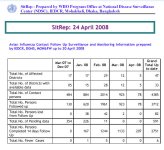
partial report from http://www.whoban.org/pdf/SitRep%20on%20AI%20on%2024%20April%202008.pdf

Bangladesh WHO report 20080424.jpg

Could the 1 fever case from January be the current confirmed case? What about the 5 from February?
 
Re: Bangladesh: first human case of H5N1 bird flu

Re: Bangladesh: first human case of H5N1 bird flu

tests completed/contacts:
----------------------------
Mar07-Dec07 : 0/130
Jan08 : 167/620
Feb08 : 1244/1961
Mar08 : 1133/923
Apr08 : 207/78


so, most open tests seem to be from Mar-Jan, while most later tests are already completed.
Presumably including most of the 5 fever-cases from February.
Seems that they first tested the later cases and now go backward.
 
Re: Bangladesh: first human case of H5N1 bird flu

Re: Bangladesh: first human case of H5N1 bird flu

Source: http://www.ipsnews.net/news.asp?idnews=42493

BANGLADESH: Human Bird Flu Case Deadly for Poultry Industry
By Farid Ahmed

DHAKA, May 24 (IPS) - Authorities here have stepped up surveillance against avian influenza after the case of a 16-month-old boy, who took ill in January, was diagnosed as one of infection with the deadly H5N1 virus.

Bangladesh become the 15th country to report a case of human infection after the Geneva-based World Health Organisation (WHO), citing results from laboratories at the Centres for Disease Control (CDC) in Atlanta, confirmed the infection on Thursday.

Since 2003, when bird flu first surfaced, 15 countries have reported a total of 382 human cases, with 241 of them turning fatal. WHO has now confirmed human cases in Azerbaijan, Cambodia, China, Djibouti, Egypt, Indonesia, Iraq, Laos, Burma, Nigeria, Pakistan, Thailand, Turkey, Vietnam and Bangladesh.

Prof. Mahmudur Rahman, a director at Bangladesh?s Institute of Epidemiology, Disease Control and Research (IEDCR), told IPS that although the boy was totally cured well before the confirmation, surveillance has been stepped up across the country.

Since the H5N1 virus was first detected in Bangladesh, at a state-run poultry farm on the outskirts of the capital, authorities have culled more than two million birds, causing losses estimated at 700 million US dollars.

With 47 of Bangladesh?s 64 districts affected, the poultry industry, introduced two decades ago to help this impoverished country, is now facing its biggest ever challenge. Affected are more than 1.5 million people employed in one of the world's largest poultry industries that produces producing 220 million chickens and 37 million ducks annually.


According to the South Asia Enterprise Development Facility, a multi-donor facility managed by the International Finance Corporation of the World Bank Group, the poultry sector supports five million people directly or indirectly through 150,000 poultry farms, constituting 1.6 percent of Bangladesh's gross domestic product (GDP).

In recent years, the poultry industry has been growing at an annual rate of about 20 percent, recording a turnover of 25 -1.5 billion dollars in 2006. Analysts say the figures for 2007 may fall below that mark thanks to drastic culling.


Battered by the culling, monsoon floods and a devastating cyclone in November, the country's once booming poultry industry is now seriously threatened. Businessmen say the outbreak has already caused the closure of more than a third of the country?s poultry farms.

As the virus spread, the state-owned Bangladesh TV and a dozen or so private cable TV channels often broadcast programmes on avian influenza making people aware of the deadly virus, but observers said impact is minimal.

??Street vendors are still selling live chickens in Dhaka, although the city corporation authority has imposed a ban on selling live chickens in the open,?? said Dhaka school teacher Sharif Ahmed.

Without disclosing the identity of the affected boy, Rahman said he lived in a crowded slum in Dhaka. His parents had bought a live chicken from a nearby market which they kept in their house for some days before slaughtering it for a meal.

The boy was among the more than 3,000 people suspected of being infected with bird flu in Bangladesh, but his was the only case that tested positive, a health department official said.

After the Bangladesh government was informed of the test results by the WHO, the national advisory committee on avian influenza met on Thursday to step up measures.

Rahman said IEDCR was already conducting surveillance measures in the districts affected by bird flu and that people who were in direct contact with poultry birds and products were being kept under observation by epidemiologists. As part of the new measures, Bangladesh will set up isolation units in all public hospitals, he said.

"Right now everything is under control.
We have trained doctors and readied hospitals to tackle any new detection," Rahman said. ??We also have trained volunteers in the villages.??

Bangladesh, which has a population of nearly 150 million, is the world's most densely populated country with nearly 1,000 people per sq km. With poultry farms set up everywhere in the country the risk of the virus spreading fast is high.

Earlier this year, India?s West Bengal state which shares a long border with Bangladesh suffered the neighbouring country?s worst outbreak of the virus among poultry. But no human cases of bird flu have been reported in India, which has also carried out massive poultry culling.

Bird flu was thought only to infect birds until the first human cases were detected in Hong Kong in 1997. Though rare, humans catch the disease through close contact with infected birds.

Experts consider vigilance and speedy action such as isolation of human cases important because of a fear that the H5N1 strain could mutate to become capable of human-to-human transmission and set off a deadly pandemic. Densely populated countries like Bangladesh, where people live in close proximity to backyard poultry or keep birds in their homes, are seen as particularly risky.

(END/2008)
 
Re: Bangladesh: first human case of H5N1 bird flu

Re: Bangladesh: first human case of H5N1 bird flu

Govt gears up bird flu preparedness

Alpha Arzu

The government plans to introduce isolation units at 33 district level public hospitals to treat patients infected with avian influenza by June, as the viral infection has already been detected in a child in Dhaka.

Besides establishing the 33 units with at least four beds each, the government will also start surveillance at 18 more district hospitals with the existing 12 where surveillance started amid the first outbreak of bird flu in March 2007, said Mahmudur Rahman, director of the Institute of Epidemiology, Disease Control and Research.

The initiatives were taken before detection of the first case of bird flue infection in human body on Wednesday, said director of disease control of the directorate general of health services, Moazzem Hossain. ?Now all the steps will be swift.?

As part of the preparedness of tackling human infection of H5N1, the government has also stocked up a large number of anti-viral drug and protective equipments, said Mahmudur Rahman.

The government has already established an 8-bed avian influenza ward at the chest diseases instate and hospital in Mohakhali with artificial ventilation system, and all drugs and facilities to treat such patients.

To diagnose the infection, the government has established a laboratory with real-time polymerase chain reaction, a rapid method for diagnosis of all kinds of influenza viruses, on the second floor of the IEDCR building at Mohakhali and invited international tenders for procurement of machinery for the laboratory, said an official of the IEDCR.

Mahmud told New Age on Saturday, ?The PCR is a method for amplifying a small amount of deoxyribonucleic acid or ribonucleic acid into large quantities in a few hours. Real-time PCR lets a scientist view the increase in DNA as it is amplified, and allows rapid screening of samples for diagnosis and disease tracking.?

The government also ordered installing a Bio Safety Level 3 Laboratory on the IEDCR premises to tackle incidence of influenza and other dangerous pathogens within four to five months. The BSL 3 Lab will be brought in from the Hong Kong.

With the assistance of international financial institutions and lending agencies, the government has already trained a large number of health professionals and people.

There are 12-member teams in districts and four-member teams at the upazila level for rapid response that have been working around the country.

Besides there are about 2,26,100 volunteers at the union that working to raise the awareness of the people. They are visiting the door to door with messages and leaflets, said health officials.

The first bird flu in human body was detected on May 21. The Centre for Disease Control and Prevention, USA, diagnosed a 16-month-old Bangladeshi child as being infected with H5N1, the virus that causes avian influenza.

The country?s first bird flu case was detected in March 2007 in poultry. About 287 farms with confirmed H5N1 virus cases were reported in 47 districts till May 21 in 2008, according to the Ministry of Fisheries and Livestock.

The government has so far exterminated more than 16,37,266 fowl and destroyed about 22 lakh eggs in 505 commercial and 42 backyard farms in the country.

The symptoms are similar to other types of flu ? fever, malaise, sore throat and coughing. Humans can also develop conjunctivitis because of the virus.

The World Health Organization confirmed 382 cases of H5N1 in humans in Azerbaijan, Cambodia, China, Djibouti, Egypt, Indonesia, Iraq, Laos, Myanmar, Nigeria, Pakistan, Thailand, Turkey and Vietnam, leading to 241 deaths, between 2003 and April 30, 2008.

http://www.newagebd.com/front.html#16

credits Ter
 
Re: Bangladesh: first human case of H5N1 bird flu

Re: Bangladesh: first human case of H5N1 bird flu

Young boy in Bangladesh recovers from bird flu-WHO
28 May 2008 15:54:27 GMT
<!-- 28 May 2008 15:54:27 GMT ## for search indexer, do not remove -->Source: Reuters

<!-- AN5.0 article title end --><SCRIPT language=JavaScript src="/bin/js/article.js"></SCRIPT></SPAN><INPUT id=CurrentSize type=hidden value=13 name=CurrentSize> <!-- Young boy in Bangladesh recovers from bird flu-WHO --><!-- Reuters -->GENEVA, May 28 (Reuters) - An infant in Bangladesh contracted H5N1 bird flu and survived, in the South Asian country's first human infection with the virus, the World Health Organisation (WHO) said on Wednesday.
In a statement released in Geneva, the United Nations agency said a 16 month-old boy from Komalapur, Dhaka, developed symptoms in late January and then recovered.
"The case was exposed to live and slaughtered chickens at his home," the WHO said. "Specimens have been collected from his family members and neighbours. All remain healthy to date."
The H5N1 virus has infected millions of birds in much of Asia, Africa, and some parts of Europe. Public health experts fear it could spark a human pandemic if it mutates into a form that passes easily between people.
A total of 383 humans are known to have been infected with the virus since 2003, and 241 have died, according to the WHO.
The Bangladeshi infection was flagged during surveillance activities by the International Centre for Diarrhoeal Disease Research Bangladesh, the WHO said. (Reporting by Laura MacInnis; Editing by Elizabeth Piper)

http://www.alertnet.org/thenews/newsdesk/L28760423.htm
<!-- news ## for search indexer, do not remove -->
 
Re: Bangladesh: first human case of H5N1 bird flu

Re: Bangladesh: first human case of H5N1 bird flu

28 May 2008 -- </SPAN>The Ministry of Health, Bangladesh has confirmed its first case of human infection with H5N1 avian influenza. The case was identified retrospectively as part of seasonal surveillance activities run by the International Centre for Diarrhoeal Disease Research, Bangladesh (ICDDRB).
The case is a 16-month-old male from Komalapur, Dhaka. He developed symptoms on 27th January 2008 and subsequently recovered. The case was confirmed as being infected with A(H5N1) by the WHO H5 Reference Laboratory, US Centers for Disease Control and Prevention (CDC). The case was exposed to live and slaughtered chickens at his home. Specimens have been collected from his family members and neighbours. All remain healthy to date.

http://www.who.int/csr/don/2008_05_28/en/index.html
 
Re: Bangladesh: first human case of H5N1 bird flu

Re: Bangladesh: first human case of H5N1 bird flu

[From WHO SEARO Website - IOH]

29 May 2008 ? Bangladesh

Outbreaks of Avian Influenza in Indonesia, India, Myanmar and Thailand have been reported among poultry.

Human cases of Avian Influenza have been reported from Bangladesh, Indonesia, Myanmar and Thailand.

Thailand has reported 25 cases with 17 deaths since December 2003.
The last human case in Thailand was reported in September, 2006.

WHO has reported 133 laboratory confirmed human cases of avian influenza in Indonesia, with 108 deaths since July 2005.

Bangladesh has confirmed its first case of human infection with H5N1 avian influenza, the case is a 16-month-old male from Komalapur, Dhaka.

The case is a 16-month-old male from Komalapur, Dhaka. He developed symptoms on 27th January 2008 and subsequently recovered.
The case was confirmed as being infected with A(H5N1) by the WHO H5 Reference Laboratory, US Centers for Disease Control and Prevention (CDC). The case was exposed to live and slaughtered chickens at his home. Specimens have been collected from his family members and neighbours. All remain healthy to date.

As of 28 May 2008, the Ministry of Fisheries and Livestock, Government of Bangladesh, reported that culling of poultry has taken place in 547 farms, spread over 47 districts.

  1. Dhaka,
  2. Gazipur,
  3. Narayangonj,
  4. Tangail,
  5. Jamalpur,
  6. Jessore,
  7. Noakhali,
  8. Gaibandha,
  9. Magura,
  10. Rajbari,
  11. Nilfamari,
  12. Dinajpur,
  13. Rangpur,
  14. Joypurhat,
  15. Lalmonirhat,
  16. Thakurgaon,
  17. Naogaon,
  18. Bogra,
  19. Feni,
  20. Pabna,
  21. Kurigram,
  22. Moulvibaza,
  23. Barisal,
  24. Barguna,
  25. Rajshahi,
  26. Natore,
  27. Patuakhali,
  28. Netrokona,
  29. Bhola,
  30. Kulna,
  31. Manikgonj,
  32. Gopalgonj,
  33. Mymensingh,
  34. Sylhet,
  35. Kustia,
  36. Jhinaidah,
  37. Norsingdhi,
  38. Bagerhat,
  39. Chittagong,
  40. Kishoreganj,
  41. Meherpur,
  42. Comilla,
  43. Shariatpur,
  44. Munshiganj
  45. Chandpur,
  46. Satkhira and
  47. B Baria.
A total of 1,637,266 chickens have been culled.
-
http://www.searo.who.int/en/Section10/Section1027/Section2095/Section2462_13930.asp
------
 
Re: Bangladesh: first human case of H5N1 bird flu

Re: Bangladesh: first human case of H5N1 bird flu

First human infection with Influenza A H5N1 confirmed in Bangladesh

The first human case of influenza A H5N1 recognized in Bangladesh and was notified to WHO by Bangladesh Government on 22 May, 2008. The case occurred in a 15 month old child from Dhaka. He developed fever and difficulty breathing, but recovered completely. His likely exposure was to a chicken that was slaughtered in his household. Physicians who see patients with serious respiratory illness should take a history of exposure to sick poultry and contact IEDCR if they suspect highly pathogenic avian influenza.
We report the first case of human infection with influenza A, H5N1 confirmed in Bangladesh. The case was identified as part of the population based surveillance in urban Dhaka. Upon laboratory confirmation of the case an investigation team re-evaluated the affected child and family and investigated potential sources for the infection.
The World Health Organization and the Food and Agriculture Organization monitor strains of influenza circulating globally to identify dangerous emerging strains with the hope that early recognition and intervention a high mortality pandemic can be avoided. Strains of Influenza A, H5N1, first identified in Hong Kong in 1997 have been circulating in Asia since 2001. These strains have caused high mortality outbreaks among poultry throughout Asia, and in many countries in Europe and Africa. The H5N1 virus is a adapted to birds, the natural host of influenza viruses. However, these strains occasionally infect humans. Among the 383 human cases of H5N1 recognized and reported to the World Health Organization by 28 May 2008, 241 (63%) had died. If the H5N1 virus develops the capacity to efficiently transmit from person to person, this could cause a deadly pandemic.
The government of Bangladesh confirmed the presence of influenza A, H5N1 virus in poultry in March 2007 and since then poultry outbreaks of H5N1 have been confirmed in 47 of the 64 districts in Bangladesh. ICDDR,B collaborates with the Government of Bangladesh on human surveillance for influenza under two broad activities, national hospital surveillance in 12 hospitals across the country and population based surveillance in a low income community in urban Dhaka.

Kamalapur is a densely populated, low-income community in Dhaka city. Since March 2004, approximately 5000 households with children under the age of 5 years are under active surveillance for respiratory illness. Each week a field worker visited participating households and referred children to the clinic who had signs of serious respiratory illness. Participating families were encouraged to bring their children to the clinic if they developed signs or symptoms of illness on days that the field worker did not come to visit them in the home. In the clinic physicians performed a standardized exam, and ordered additional studies based on specific findings. Every fifth child from the surveillance area who met the criteria for acute infectious respiratory illness had a nasopharyngeal wash specimen collected. An aliquot of the nasopharyngeal washes was placed on tissue culture in the Virology Laboratory of ICDDR,B, and incubated. If cytopathic effect was noted, the tissue culture supernatant was collected and a haemagglutination inhibition test conducted using the standard WHO influenza reagent kits for Influenza A (H1N1), Influenza A (H3N2), Influenza B Shanghai and Influenza B/Hong Kong.

A 15 month old Kamalapur resident developed cough and runny nose on 22 January 2008. By 27 January his breathing was labored. On 29 January his mother brought him to the ICDDR,B clinic in Kamalapur. On examination the child had a temperature of 38.1 ?C, a respiratory rate of 40 breaths per minute, pulse of 124, weight for age was the 78th percentile and there were no abnormal sounds on chest auscultation. Because the child was part of the active surveillance system, a chest radiograph was obtained. The child was also selected as one of the one in every 5 children selected for nasopharyngeal wash and influenza culture.

The initial clinical impression was enteric fever. The child was treated with amoxicillin. The chest radiograph was later interpreted as showing an alveolar infiltrate. Because the child was in the surveillance system, a field worker visited him daily at his home. He was also seen in the clinic for follow-up on 31 January, 5 February, 10 February and 13 February. Although the mother reported the child had fever at home as late as 7 February, an elevated temperature was not identified after the initial clinic visit. The child completed a 13 day course of amoxicillin. On his last clinic visit on 13 February the child was clinically well. The final clinical diagnosis was upper respiratory tract infection. The child was re-evaluated on 22 May and remained clinically well.

The culture of the child?s nasopharyngeal wash specimen showed cytopathic effect typical of influenza virus, reacted against antibody to influenza A, but the specimen did not agglutinate with H1 or H3 antisera. The specimen was forwarded to the Centers for Disease Control in Atlanta, Georgia for further characterization. At the Centers for Disease Control the isolate was confirmed as a highly pathogenic Influenza A, H5N1, by anti-sera agglutination and real time PCR. The viral genome was sequenced. It was a clade 2.2 virus.

The infected child lived with his mother, sister, and father in a one room residence in the Kamalapur community. The child?s father bought a live broiler chicken from a poultry shop located 50 meters from the residence at 11:00 am at some time in January. He kept the chicken near the door of their one room house where the affected child was sleeping. At 12:00 pm, the child?s mother with the help of her next door neighbor slaughtered the chicken inside the bathroom near the tap. While they were slaughtering the chicken, the child was sleeping and immediately after the processing of the chicken, the child awoke. Neither the mother nor the neighbor washed their hands. The mother handed the child to the neighbor. The mother gathered all the entrails, organs and other wastes of the chicken in a polythene bag, tied a knot in that bag and kept it near the main entrance of the house. The waste bag remained there for about two hours.

The poultry shop where the father bought the chicken sold an average of 15 chickens per day. The owner purchased chickens from the Jatrabari whole sale market in Dhaka. One day during the first three weeks in January he recalled that three of the chickens that he purchased died on the same day. This was quite an unusual event. Poultry wholesalers at the Jatrabari whole sale poultry market report purchasing their poultry mostly from Savar, Gazipur, Norshingdi, Munshigonj, Brahmanbaria, and Commilla outside Dhaka. During January they recalled that deaths among poultry in cages occurred commonly averaging among 5 ? 10% of chickens each day. Fifty outbreaks of H5N1 were confirmed in Bangladesh in January.

The mother also reported that the child ate a soft boiled egg each day in January. None of the child?s family members reported illness during the time that the index child was ill nor in the following two weeks.

Reported by:
Institute for Epidemiology Disease Control and Research (IEDCR), Ministry of Health and Family Welfare, Government of the People?s Republic of Bangladesh


http://www.iedcr.org/Default.aspx?tabid=52
 
Back
Top