
• FluTrackers.com Inc. does not provide medical advice. Information on this web site is collected from various internet resources, and the FluTrackers board of directors makes no warranty to the safety, efficacy, correctness or completeness of the information posted on this site by any author or poster. The information collated here is for instructional and/or discussion purposes only and is NOT intended to diagnose or treat any disease, illness, or other medical condition. Every individual reader or poster should seek advice from their personal physician/healthcare practitioner before considering or using any interventions that are discussed on this website. By continuing to access this website you agree to consult your personal physican before using any interventions posted on this website, and you agree to hold harmless FluTrackers.com Inc., the board of directors, the members, and all authors and posters for any effects from use of any medication, supplement, vitamin or other substance, device, intervention, etc. mentioned in posts on this website, or other internet venues referenced in posts on this website.
  • We are not asking for any donations. Do not donate to any entity who says they are raising funds for us.

Egypt fears of bird flu mutation

Sally Furniss

Well-known member
Egypt fears of bird flu mutation

http://news.bbc.co.uk/2/hi/programmes/file_on_4/6441899.stm

By Jenny Cuffe
BBC File On 4

Scientists in Egypt are examining the possibility that the deadly H5N1 Avian flu virus could be changing into a deadlier strain.

Dr Suhir Hallaj, director of the World Health Organization's communicable disease programme says there is particular concern that previous victims in Egypt have suffered from respiratory problems.

Nadia Hafez, who died in Egypt's Fayoum region last month, experienced multi-organ failure which failed to respond to anti-viral drugs.

So far the Egyptians who have died had direct contact with birds, but there is a fear the virus will cross the species barrier causing a pandemic which will disrupt world economies and claim lives on an unprecedented scale.

Egypt, which is a high risk area for avian flu and a gateway to Africa, is under growing pressure from the international community to control the spread of bird flu among poultry.

With mutations and an increase in mortality, things shouldn't be taken lightly
Health Minister Hatem el-Gabaly
A UN-commissioned report accused the Egyptian government of lacking commitment and failing to develop a national strategy.

Partner agencies within the UN were also criticised for a lack of co-ordination.

The report questioned Egypt's ability to plan and execute a credible response to the threat of pandemic.

'Mouth-to-bird' feeding

Health Minister Hatem el-Gabaly, who chairs Egypt's Supreme Committee on avian influenza, admitted it would take three to four months to develop a national plan but said Egypt could not afford to do it alone.

Feeding a bird in Egypt
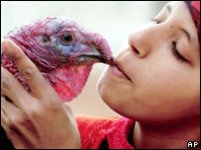
_42671923_birfeed_ap203.jpg
Egypt's bird feeding culture dates back to the Pharaohs

The country needs $66m to meet its targets for tackling bird flu, but none of the money pledged at a donors' meeting in Bamako, Mali, in December has arrived.

"The world's not taking Africa seriously", said Mr Gabaly. "Even though it is the backyard of Europe and close to the US."

"With mutations and an increase in mortality, things shouldn't be taken lightly."

Five million Egyptians keep chicken and ducks in their homes and backyards, providing an essential source of food and income.

Women feed their birds by chewing corn and blowing it into their mouths, a tradition that dates back to the days of the Pharaohs.

These households will be difficult to regulate.

Concealment

When Nadia Hafez was diagnosed with bird flu in February, Fayoum governorate sent in a veterinary team and police to cull poultry within two kilometres (1.2 miles) of her home.

Health chief, Hussein Abu Talib, said in the village of Itsa they were only able to find about 20 birds out of a total of thousands.

Avian flu virus
Scientists fear the deadly H5N1 strain of avian flu could be mutating

"When they hear the police car's horn they start hiding the birds."

A compensation scheme for the commercial sector was stopped when some farmers were discovered passing sick birds to each other so that they could all claim.

Domestic poultry keepers have never received a penny for birds that have been culled and they are sometimes reluctant to report cases of disease.

Only half of the last year's 110 outbreaks of avian flu were reported.

The rest were discovered by spot checks and officials worry this may be only a fraction of the total.

Commercial poultry farmers now vaccinate all their birds and believe this has helped bring the disease under control.

And the government wants to do the same in people's backyards.

It is setting up a pilot scheme in three governorates to offer a vaccinated chick for every bird that is culled.

Vaccination doubts

In Fayoum, veterinary officials have been offering free vaccination since May 2006.

But the under-secretary of the veterinary service in Fayoum, Mustapha Awis, said it is difficult to keep up with the work because the birds are quickly eaten or sold.

"As soon as we get out of one street, the next day they have new poultry. It's a big challenge for us."

The Egyptian government is asking donors to contribute $450m to its vaccination programme, but one of the world's leading experts on avian flu questioned whether this is the right use of limited resources.

Dr Michael Osterholm, director of the Center for Infectious Disease Research and Control in the US, pointed to the poor record of poultry vaccines in China and Vietnam.

He said vaccines may do more harm than good, by keeping birds from dying but allowing them to continue transmitting the virus.

"We are pressuring countries into launching these extensive vaccine campaigns as a way of saying that we're doing something. It would be better to spend those same funds on preparing countries for flu instead of trying to prevent it."

Dr Osterholm said the world should put more money into developing a generic vaccine to protect humans from the disease.

"It will become irrelevant which country is the original site of a pandemic strain. The virus will spread so quickly that we will all be in the soup at the same time."

Hear the full story on Radio 4: File on 4 Tue 20 Feb 2007 at 2000 GMT
 
Re: Egypt fears of bird flu mutation

Women feed their birds by chewing corn and blowing it into their mouths, a tradition that dates back to the days of the Pharaohs.
Yikes! That is just one high-risk behavior in these H5N1 days....
 
Re: Egypt fears of bird flu mutation

Hear the full story on Radio 4: File on 4 Tue 13 March 2007 at 2000 GMT

http://news.bbc.co.uk/1/hi/programmes/file_on_4/
Egypt fears of bird flu mutation
Scientists fear a woman who died in Egypt had a mutant form of the Avian flu virus, File on 4 is told.
http://www.bbc.co.uk/radio/aod/main...bbc.co.uk/radio/aod/news.shtml?radio4/fileon4

This is well worth a listen (it's ca. 35 minutes in length). There's no transcript yet, but the beeb's website says transcripts are usually up within two weeks.

One of the highlights was an interview (around minute 24) with Egypt's WHO representative, Dr Zuhair Hallaj, who talked about multi-organ failure in the most recent cases:
Dr. Hallaj: "In all the six cases which died lately in Egypt - in five of them we have seen this multi-organ failure. We cannot say whether this is due to a delay in coming to the hospital and accordingly the anti-viral we have against the disease might not work if it is given after 48 hours of the appearance of symptoms -- or it is to a more virulent virus -- but most probably it is a more virulent virus because clinically we have seen a new picture. We have a multi-organ infection - a multi-organ failure - it is not only the respiratory tract."

Q: "So the nature of the symptoms has changed?"

Dr. Hallaj: Yes, to some extent the severity and the nature -- of course there is respiratory infection and there is the pneumonia -- the viral pneumonia -- but in addition to that we have seen renal failure -- we have seen bone marrow supression -- and we have seen liver failure. But still we haven't seen such a clinical picture in the early cases although they were late in coming to the hospital, too."

Q: "That makes you worry that the virus may be changing and becoming more aggressive?"

Dr. Hallaj: Yes, yes, yes.
Also, the Chief Executive Al Fayuum Health District, Hussein Abu Taleb, describes their efforts (including the difficulties of people hiding birds, etc) to fight bf in Al Fayuum. He sounds exhausted:
[Avian influenza] constitutes now 60% of our effort. Every night we spend two, three hours -- two, three hours -- with the governor seeing what number of patients have been reserved to the fever hospital and the results of the analysis. We need manpower -- we need volunteers -- we need vaccinations. It's a big problem.
 
Re: Egypt fears of bird flu mutation

Q: "That makes you worry that the virus may be changing and becoming more aggressive?"

Dr. Hallaj: Yes, yes, yes.


not very good news is it,i wonder how close it is to becoming a human H2H virus,i was hoping we might miss it at least for another flu season,and we might have at least another year before anything happens.
 
Re: Egypt fears of bird flu mutation

Not very good news is it,i wonder how close it is to becoming a human H2H virus,i was hoping we might miss it at least for another flu season,and we might have at least another year before anything happens.

In country after country, reporting actual H5N1 developments / cases is being delayed by a number of repeating factors:

** Resistance by locals to giving up their chicken flocks (whether sick or not)

** Reticence on the part of locals to report suspected human cases for fear that their chickens will be taken away and the local economy will be hurt

** Delays in reporting verification of actual H5N1 virus found in patients.

** Delays in health agencies in discovering / reporting mutations in H5N1's presentation of infectivity / disease menifestations

** Local health workers being overwhelmed by case loads

>>>> One wonders how long of a delay there will be in reporting th the newswires there will be when an actual h2h2h2h2h pandemic really breaks out. <<<<<
 
Re: Egypt fears of bird flu mutation

Egyptian woman dies of bird flu
A 37-seven-year-old Egyptian woman has died of bird flu, bringing the number of confirmed deaths from the virus in Egypt to 13.

The woman, Nadia Abdel Hafez, came from Fayyoum - an area well known in Egypt for poultry breeding.
Reports from Egypt say she kept poultry in her home.
Egypt has the largest known number of human cases of bird flu outside Asia. Most of those who have contracted the virus have died.
The latest fatality is the second this month in Fayyoum.
Of the 12 people who have died from the illness in Egypt, 11 have been women.


Women and girls are often responsible for looking after poultry in Egypt.
The virus has been detected in at least 19 of the country's 26 provinces.
Mutation
There are fears that the latest victims of avian influenza had been infected with a mutated strain of the virus.
The World Health Organization recently announced that two of those who had died in Egypt had been infected with a strain of the virus that was showed moderate resistance to the antiviral drug, Tamiflu.
More than 80 people have died of H5N1 bird flu since the disease's resurgence in December 2003 - most of them in South East Asia.
Experts point out that cross-infection to humans is still relatively rare and usually occurs where people have been in close contact with infected birds.
But they say if the H5N1 strain mutates so it can be passed between humans, it could become a global pandemic.


Story from BBC NEWS:
http://news.bbc.co.uk/go/pr/fr/-/2/hi/middle_east/6368821.stm


Published: 2007/02/16 14:02:22 GMT
 
BBC Radio program on H5N1 in Egypt

BBC Radio program on H5N1 in Egypt

Egypt fears of bird flu mutation

The first of the links below is to an excellent factual program looking at the reality on the ground in Egypt and some interviews with Nabaro, Osterholm et al.
The second is to a short related article on their web site.

http://news.bbc.co.uk/2/hi/programmes/file_on_4/default.stm?focuswin

http://news.bbc.co.uk/2/hi/programmes/file_on_4/6441899.stm

I know that some BBC media content is inaccessible to non UK IP addresses; if this is the case and you would like to hear this program please PM me with an Email address and I will send you the MP3 (15Mb).
 
Re: Egypt fears of bird flu mutation

All cases with M230I have died.

http://www.recombinomics.com/News/02190702/H5N1_Egypt_Emerge_Converge.html

Emergence and Convergence of H5N1 M230I in Egypt
Recombinomics Commentary
February 19, 2007


Recent NAMRU-3 generated sequences from H5N1 isolates from patients and poultry in Egypt, provide additional examples of the emergence and convergence of M230I. M230I was first reported in the first confirmed human case this season, in Gharbiya in October. The same change was found in the two sequences from the Gharbiya cluster. The similarity between the HA, NA, MP, and NS sequences from the two family members strongly indicate that the third family member was also fatally infected with H5N1 containing M230I.

The sequences coding for M230I in the above patients was also found in poultry in Egypt. These sequences are also in recent H5N1 sequences in China. However, M230I in poultry was also found in isolates with sequences that matched H7N3 in England as well as two H5N1 in Asia, A/duckGuangdong/173/04 and A/Ck/Hong Kong/2133.1/2003. This coding for M230I has now also been detected in a poultry isolate from this month as well as the most recent H5N1 patient (37F) from Fayyoum.

Thus, both versions of M230I have been identified in NAMRU-3 generated poultry and human sequences in Egypt. M230I is in most isolates, extending from the first reported sequence from this season, to the most recent human sequence. These sequences contain polymorphisms found in Qinghai H5N1 isolates and also have the regional markers that were present in the isolates from Egypt last season.

However, overlaid on this genetic background from last season are ?new? polymorphisms, which include M230I, which is in the majority of the human and bird isolates tested to date. The acquisition of the new polymorphisms also appears to be via recombination, because sets of polymorphisms on multiple gene segments can be found in recent H5N1 isolates in China and the exchange pf genetic information between Qinghai H5N1 and the distinct, non-Qinghai H5N1 in Asia has been described repeatedly. These combinations include HA V223I and NA M31I in the Gharbiya cluster and Shantou geese isolates or the HA M230I in the recent sequence from Fayyoum as well as the NA polymorphism G707C which are present in the two H5N1 isolates listed above.

The widespread detection of M230I in Egypt is cause for concern. M230I is in the three major seasonal flu strains, H1N1, H3N2, and influenza B, which are efficiently transmitted human-to-human. Moreover, M230I is also in H7 isolates, which have also been shown to efficiently transmit human-to-human. M230I is also in H3N8 which has been found in horses and is efficiently transmitted dog-to-dog. Moreover, all cases in Egypt with reported M230I have died.

The detection of M230I in the majority of human or bird sequences raises concerns that M230I is becoming fixed in Egypt. M230I has not been previously reported in the Qinghai strain of H5N1, which has another human polymorphism, PB2 E627K, which has become fixed in the Qinghai strain.

Media sources

Phylogenetic Trees
 
Re: Egypt fears of bird flu mutation

Niman (from Recombinomics) said:
...M230I, near the receptor binding domain.

Changes in the receptor binding domain are cause for concern because they can alter the ease of transmission.

http://www.recombinomics.com/News/10220603/H5N1_M230I.html
Dr. Niman -- you talk about the changes in M230I as being of concern 'cause this could alter the ease of transmission.

In the BBC interview, Dr Zuhair Hallaj was talking about changes in the clinical presentation of the disease -- i.e. multi-organ failure in addition to the respiratory problems.

Could a change in M230I also 'cause'/account for the clinical changes Dr. Hallaj was talking about?

Thanks!
 
Re: Egypt fears of bird flu mutation

Dr. Niman -- you talk about the changes in M230I as being of concern 'cause this could alter the ease of transmission.

In the BBC interview, Dr Zuhair Hallaj was talking about changes in the clinical presentation of the disease -- i.e. multi-organ failure in addition to the respiratory problems.

Could a change in M230I also 'cause'/account for the clinical changes Dr. Hallaj was talking about?

Thanks!
Yes, changes in the receptor binding domain can alter tissue tropism, which could lead to chnages in the clinical presentation. The receptor binding domain controls which tissue types can be easily infected and since M230I is in all three human strains (H1N1, H3N2, influenza B), it may be able to attack more human cell types, especially when combined with the Qinghai HA cleavage site, GERRRKKR, as well as PB2 E627K.
 
Re: Egypt fears of bird flu mutation

Let me talk of a growing concern I have.

On this site, we have pretty good anecdotal evidence, obtained via machine translations of foreign newspaper Websites, that in both Egypt and Indonesia, the number of suspected human H5N1 cases is growing. Yet it is almost impossible to get media confirmation of this unless/until the WHO certifies the presence of the disease.

We have word via the Jordanian press of an emergency WHO meeting in Cairo that goes undetected in the global media.

We have the BBC reporting the Egyptian government's alarm at the increased number of reported cases, the possible presence of a transformed virus (what I will call the "Niman M230I recombination") and the heightened surveillance in the region.

And we have the story of the Egyptian farmers who are "going underground" and not reporting cases of sickened poultry (and maybe sickened family members).

Am I off base here, or is everyone else very concerned about the situation in Egypt and Kuwait as well as Indonesia? Why was the Kuwaiti government so insistent on testing so many people for H5N1? And what of the 28 "non-negatives" the Kuwait report spoke of?

I think we need to discuss this situation further. There are obvious holes in surveillance of both the situation and the press' surveillance of the situation. I smell a bigger story brewing here, and we need to get someone(s) in there to report what the heck is going on.

Dr. Niman, a few weeks ago you spoke of some developments in Egypt that would start coming out. Are things connected?
 
Re: Egypt fears of bird flu mutation

scottmcpherson said:
...is everyone else very concerned about the situation in Egypt and Kuwait as well as Indonesia....
Yup!! Didn't help to listen to that BBC report. The official from Al Fayuum just sounded like he was at his wits' end.
 
Re: Egypt fears of bird flu mutation

Yes, changes in the receptor binding domain can alter tissue tropism, which could lead to chnages in the clinical presentation. The receptor binding domain controls which tissue types can be easily infected and since M230I is in all three human strains (H1N1, H3N2, influenza B), it may be able to attack more human cell types, especially when combined with the Qinghai HA cleavage site, GERRRKKR, as well as PB2 E627K.
Thanks, Doc. Ugh. :(
 
Re: Egypt fears of bird flu mutation

Let me talk of a growing concern I have.

On this site, we have pretty good anecdotal evidence, obtained via machine translations of foreign newspaper Websites, that in both Egypt and Indonesia, the number of suspected human H5N1 cases is growing. Yet it is almost impossible to get media confirmation of this unless/until the WHO certifies the presence of the disease.

We have word via the Jordanian press of an emergency WHO meeting in Cairo that goes undetected in the global media.

We have the BBC reporting the Egyptian government's alarm at the increased number of reported cases, the possible presence of a transformed virus (what I will call the "Niman M230I recombination") and the heightened surveillance in the region.

And we have the story of the Egyptian farmers who are "going underground" and not reporting cases of sickened poultry (and maybe sickened family members).

Am I off base here, or is everyone else very concerned about the situation in Egypt and Kuwait as well as Indonesia? Why was the Kuwaiti government so insistent on testing so many people for H5N1? And what of the 28 "non-negatives" the Kuwait report spoke of?

I think we need to discuss this situation further. There are obvious holes in surveillance of both the situation and the press' surveillance of the situation. I smell a bigger story brewing here, and we need to get someone(s) in there to report what the heck is going on.

Dr. Niman, a few weeks ago you spoke of some developments in Egypt that would start coming out. Are things connected?

The smoking gun was on Tamiflu resistance (NA`N294S), and although the gun is still smoking, I think it is safe to say that more on N294S will be coming out.
 
Re: Egypt fears of bird flu mutation

does anyone else think that this virus isnt far away from becoming a human only virus i.e. H2H2H,or am i being too premature.?
 
Re: Egypt fears of bird flu mutation

Well it does appear to be moving in that direction. How imminent the threat is however is still debateable.
 
Re: Egypt fears of bird flu mutation

Would the failed vaccination program in the Nile Delta region have any effect on the mutations?

Bird flu detected in vaccinated Egypt flocks - source
Tue Mar 13, 2007 11:19 PM IST

By Cynthia Johnston
CAIRO (Reuters) - Egypt has detected bird flu in chickens and ducks from reportedly vaccinated flocks in a sign that inoculation procedures in the most populous Arab country may be lacking, an animal health official said on Tuesday.
The official, who closely follows bird flu in Egypt, said chickens and ducks from vaccinated household flocks and on poultry farms had tested positive for the H5N1 bird flu virus this year in 12 locations, and eight of the infections were detected this month.
"We have outbreaks in vaccinated chickens in many places," the official told Reuters, asking not to be named because he was not authorised to speak to the press. "This puts a question mark on vaccination procedures ... It is dangerous."
He said all but one of the vaccinated flocks where infections occurred were in the hard-hit Nile Delta, where most of the country's 24 human cases have been concentrated. The country has the largest number of human cases outside of Asia.
Since the virus first surfaced in Egyptian poultry a year ago, 13 Egyptians have died of the disease, and all but two human infections have been attributed to contact with sick or dead household birds.
Egyptian authorities have said they had virtually eliminated the disease from poultry farms and hatcheries, where birds are routinely vaccinated.
An agriculture ministry avian specialist, Saber Abdel Aziz Galal, confirmed that bird flu had been detected in two Nile Delta flocks that were reportedly vaccinated, but said they had occurred in January. He was unaware of other cases.
Ahmed Chikhaoui, the Food and Agriculture Organisation representative in Cairo, said he was unaware of detected cases in vaccinated flocks.

http://in.today.reuters.com/news/Ne...231052Z_01_NOOTR_RTRJONC_0_India-290826-1.xml
 
Re: Egypt fears of bird flu mutation

http://www.emro.who.int/rd/AnnualReports/2005/pdf/Organogram.pdf


Its important to understand who Threasa42 is quoting in post#4.

There's an WHO EMRO org chart on the PDF file. page1 of 1. (271KB)
Dr Zuhair Hallaj, Is or was at the top of the org chart and there are 22 country's on that chart.

In terms of Rapid Response and Containment, a mutation, an actual change in the virus is required before a phase change from 3 to 4. ( not that they would do that ) but,
Moving from phase to phase requires a change in the virus itself.

Then again maybe its only be a political 'Signal' ie, "you better start sending the aid money or else ."


http://www.doh.state.fl.us/disease_ctrl/epi/conf/sat/BroadcastRapidResponse_Final.txt

The WHO Phases of an Influenza Pandemic, Condensed
* Phase 3 – now – novel influenza strain in birds, rare transmission from birds to people, even rarer transmission between people.
* Phase 4 – like 3, but with more person to person spread
* Phase 5 – like 4, but even more so.
* Phase 6 – virus is circulating that is capable of sustained person to person transmission – that is, of causing a pandemic

Phases are about the Virus
* WHO will use epidemiologic and virologic evidence to decide which phase we are in.
* A phase 3, 4 or 5 virus is inherently not capable of sustained person-to-person spread -- outbreaks will stop even with no control measures.
* Moving from phase to phase requires a change in the virus itself.
* Recent incident in Indonesia illustrates WHO’s approach here:
* Two generations of person-to-person spread, but identical virus
* No change from phase 3.

edit to add:
I'm not as sure what Dr Zuhair Hallaj position is now. But in 2006 he was.

Dr Zuhair Hallaj (WHO Secretariat and Chairperson)
Director, Communicable Disease Control
WHO Regional Office for the Eastern Mediterranean
Cairo.
 

Attachments

Last edited:
Back
Top