• FluTrackers.com Inc. does not provide medical advice. Information on this web site is collected from various internet resources, and the FluTrackers board of directors makes no warranty to the safety, efficacy, correctness or completeness of the information posted on this site by any author or poster. The information collated here is for instructional and/or discussion purposes only and is NOT intended to diagnose or treat any disease, illness, or other medical condition. Every individual reader or poster should seek advice from their personal physician/healthcare practitioner before considering or using any interventions that are discussed on this website. By continuing to access this website you agree to consult your personal physican before using any interventions posted on this website, and you agree to hold harmless FluTrackers.com Inc., the board of directors, the members, and all authors and posters for any effects from use of any medication, supplement, vitamin or other substance, device, intervention, etc. mentioned in posts on this website, or other internet venues referenced in posts on this website.
  • We are not asking for any donations. Do not donate to any entity who says they are raising funds for us.

House Prices

Re: House Prices

The one guaranteed gold standard reality in my lifetime and historically, as I read it, is that the analysts and forecasters who are MSM really cause severe economic damage to those who heed their advice.

I have zero tolerance for them. You all well know my views on WHO virological "leadership" and the "leadership" of the famous virological-MSM people who have espoused reassortment and random mutation.

Here, in this nauseating, "Duh, we're surprised" article on R/E prices, which sounds just like the "Duh, we're surprised" pronouncements from the above, we see a total failure to understand that reality is not history, but reality is the direction of the trend at the margin. Bird flu, at the margin, now, today, is a heck of a lot worse than it was 2 years ago, or a year ago. And that means, due to the failure of TPTB to see that the relevant factor to consider is trend will assure us yet again another eviscerating "Duh, we're surprised" soon to be issued by the virological "leadership".

Note this article well... learn this psycho-political fact. Life is a lot easier as one can anticipate the "Duh, we're surprised" pronouncements before they arise and memorialize prior failure to think unlike a scientist, and certainly unlike each and every person who stands up and says, "Duh, I'm surprised." When you see those folks, they are the ones to distrust. You can make your own list. And you can act according to your own recognition that "a trend in motion stays in motion"...until the trend changes. Trends don't change often, but when they do, they really do. In the world of R/E, as FL1 said and did and some others did, it was time to say goodbye at or near the top. This time, yet again, the pigs are now penned and will get slaughtered.

Housing Drag on U.S. Economy May Let Fed Stay on Hold (Update2)
By Joe Richter and Kristy McKeaney
Sept. 8 (Bloomberg) -- The faltering U.S. housing market will be more of a drag on growth than economists expected a month ago, allowing Federal Reserve policy makers to hold interest rates steady through the first half of next year, according to a monthly survey by Bloomberg News.
Gross domestic product, the sum of all goods and services produced in the country, will expand at an average annual rate of 2.8 percent this quarter and slow to 2.6 percent in the final three months of 2006, according to the median forecast of 81 economists surveyed Sept. 1 through Sept. 7. The fourth quarter estimate is a 10th of a percentage point lower than the prior survey. Growth averaged 4.3 percent in the first half.
Flagging home sales resulting from higher mortgage rates will remove a source of cash that helped drive consumer spending and economic growth during the five-year housing boom, economists said. The Fed's monthly regional survey showed consumer spending last month rose ``slowly'' and growth faded in some areas, strengthening the case for holding rates steady.
The housing market is declining ``a little more quickly than we had expected at the beginning of the year,'' said Scott Anderson, an economist at Wells Fargo & Co. in Minneapolis. ``It's not signaling a recession, but we do see a growth slowdown ahead.''
Economists expect the economy to expand at an average rate of 2.7 percent in the first half of next year, down slightly from the prior survey as economists shaved a 10th of a point off their second-quarter forecasts.
Realtors Cut Forecast
The National Association of Realtors, the U.S. real estate industry's largest trade group, yesterday reduced its 2006 forecast for home sales, saying a record number of houses on the market may cause prices to fall for the first time since 1993. The Standard & Poor's 500 Homebuilding Index has dropped more than a third this year, the worst performance on the S&P 500.
The housing market ``went from overheated to back-to-normal to under-heated,'' Ara Hovnanian, chief executive officer of Hovnanian Enterprises Inc., said yesterday. Hovnanian, New Jersey's largest homebuilder, said fiscal third-quarter profit fell 34 percent.
The slowdown in housing will leave consumers with less cash from refinancing and home-price appreciation, which lifted spending during the housing boom that ended last year. Higher fuel costs are also pinching consumers.
Household spending growth is forecast to average 3.1 percent for 2006 and slow to 2.6 percent in the first quarter of next year. The first-quarter forecast is a 10th of a percentage point lower than in the previous survey.
Soft Landing
The cooling real estate market ``does mean consumer spending will be lower, but that's consistent with the soft landing that the Fed is trying to achieve,'' said John Calverley, London-based chief economist at American Express Bank Ltd., in an interview today.
Prices of consumer goods will rise 3.6 percent this year, the same as estimated last month, the survey showed. Price gains will ease to 3.2 percent in the first quarter and 2.7 percent by mid-year, the survey showed.
Increased competition and the prospect of waning demand may deter companies from raising prices to recoup energy costs. The Fed said this week in its regional survey, known as the beige book, that companies had difficulty passing along higher energy prices to customers, easing concerns that higher raw materials costs would lead to broader inflation.
Fed Pauses
The rate-setting Federal Open Market Committee voted last month to leave the overnight lending rate at 5.25 percent, ending a run of 17 consecutive quarter-point increases.
Cleveland Fed President Sandra Pianalto that while she is still concerned about elevated inflation readings, ``I viewed the pause as appropriate to give me the chance to accumulate more information.''
``The overall pace of economic activity -- especially housing activity -- had begun to moderate, and the full effect of the FOMC's previous rate increases had not been felt,'' she said in remarks today to the Copper Development Association in Oak Brook, Illinois.
Fed policy makers will leave rates at that level through the first half of next year before cutting a quarter-point, the Bloomberg survey showed. That forecast is unchanged from the prior survey.
Interest-rate futures yesterday showed the chance of the Fed raising its benchmark rate 25 basis points before Dec. 31 is about 16 percent, down from 78 percent at the beginning of August.
Productivity, Labor Costs
Still, figures from the Labor Department this week showed inflation pressures persist. The productivity of U.S. workers slowed last quarter and labor costs jumped in the first half by the most in six years, the report showed. Anderson expects the Fed to increase its interest rate target another quarter point before the end of the year.
Job gains and income growth will keep consumer spending from plunging as housing slumps, economists said.
Employers added 128,000 workers to their payrolls in August, up from a revised 121,000 in July, the Labor Department reported last week. The jobless rate declined to 4.7 percent from 4.8 percent. Unemployment averaged 5.1 percent last year and about 5.6 percent during the record expansion from 1991 to 2001.
The jobless rate will hold at 4.7 percent this quarter and rise to 4.8 percent in the final three moths of this year, according to the Bloomberg survey. It will average 4.9 percent through the first half of next year, the survey showed.
U.S. consumer spending during July rose the most since January, a report last week showed. Sales at U.S. stores open at least a year in the week ended Sept. 2 increased 3.9 percent on a year-over-year basis, the biggest rise since June 24, the International Council of Shopping Centers said in a Sept. 6 statement.
To contact the reporter on this story: Joe Richter in Washington at Jrichter1@bloomberg.net ;
Last Updated: September 8, 2006 11:18 EDT
http://bloomberg.com/apps/news?pid=20601068&sid=ahGoyA7DHRo4&refer=economy
 
Re: House Prices

Let's look at a bit of the Bloomberg (upchuck) article:

> Gross domestic product, the sum of all goods and services produced in the country, will expand at an average annual rate of 2.8 percent this quarter and slow to 2.6 percent in the final three months of 2006, according to the median forecast of 81 economists surveyed Sept. 1 through Sept. 7. The fourth quarter estimate is a 10th of a percentage point lower than the prior survey. Growth averaged 4.3 percent in the first half.

No mention of inflation!! Haha. The USD is declining against the Chinese Yuan at the rate of 6% per annum. In this paragraph there's no mention of inflation. They didn't say, "Hey, inflation is 3%-6%; so that means GDP will in fact DECLINE nearly 3% or at best GDP will be flat, year to year."

The dishonest MSM and those quoted did not say those things. Does this make them liars? Does this make them dolts? Do they know something that I don't?

And here's another lalapalouza:
> The housing market is declining ``a little more quickly than we had expected at the beginning of the year,'' said Scott Anderson, an economist at Wells Fargo & Co. in Minneapolis. ``It's not signaling a recession, but we do see a growth slowdown ahead.''

I really get disgusted with people who say these things. How do you feel about this? You know this is an "economist" who is incapable of forecasting accurately...yet he works at a major international bank. Do you get the message? Do you trust this person? Do you believe that the decline is "not signaling a recession"?

The answer given in this article, above, is that the reason there's no recession coming is this:
>The cooling real estate market ``does mean consumer spending will be lower, but that's consistent with the soft landing that the Fed is trying to achieve,'' said John Calverley, London-based chief economist at American Express Bank Ltd., in an interview today. > Prices of consumer goods will rise 3.6 percent this year, the same as estimated last month, the survey showed. Price gains will ease to 3.2 percent in the first quarter and 2.7 percent by mid-year, the survey showed.

Where that consumer is getting money to spend is from thin air, the last bucks left in the account from their prior borrowings. Everyone's spending in the hope they'll stop the drop! Or, enjoy it while we can, because it's about to be closed off. It's laughable; comedic relief.

And the fact that consumer price index will rise 3.6% when GDP will expand at 2.8% is simply stated in the article but then ignored. Let's see, 2.8 - 3.6 = DEFICIT OF 0.8. Where does that come from? Ah ha! It comes from the Idiocracy. Great. It's very reassuring to me to be an American and trust my govt, my economic leadership, and my business reportors.

My reaction when I read this tripe is, "Get me outta here".
 
Falling House Prices in U.S. affect Canada

Falling House Prices in U.S. affect Canada

OTTAWA, Sept 7 (Reuters) - Canada has received assurances from Washington and the International Monetary Fund that the slowdown in the U.S. housing market is manageable, Finance Minister Jim Flaherty said on Thursday.
Canadians are bracing for the fallout from a cooling U.S. economy, which buys over 80 percent of Canada's exports.
But Flaherty said the downturn was no surprise to Ottawa and that, so far, there were no signs it would hurt the country's fiscal health. He spoke to reporters by telephone from a meeting of Asia-Pacific finance ministers in Vietnam, where U.S. Treasury Secretary Henry Paulson was also in attendance.
"We are comfortable with the softening in that market and I'm in fact comfortable with what I was hearing today from Secretary Paulson here in Hanoi and from the World Bank and the IMF that it's a situation that is manageable," Flaherty said.


Flaherty has frequently said a sharp downturn in the U.S. housing market was a top risk for the Canadian economy. The Bank of Canada this week tagged declining U.S. household demand as a key downside risk to the otherwise robust economy.
"We anticipated some softening in the U.S. housing market. It was anticipated as we were preparing the budget for this year in Canada," Flaherty said. "So far we're on track for what we anticipated in budget 2006. We're watching the situation of course."
Canada's minority Conservative government will meet its promised target of cutting its budget by at least C$1 billion ($900 million) this fiscal year, and plans to announce those cuts later this month, Flaherty said.
"We've been monitoring our spending carefully and we'll be able to speak to that issue directly, about reductions in spending, and also frugality in spending, later in the month of September," he said.


© Reuters 2006. All Rights Reserved.
<SCRIPT language=JavaScript src="http://i.today.reuters.com/script/googleAd.js"></SCRIPT><LINK href="http://i.today.reuters.com/styles/GoogleAd.css" type=text/css rel=stylesheet><TABLE cellSpacing=0 cellPadding=0 width="100%"><TBODY><TR><TD>


http://today.reuters.com/news/articleinvesting.aspx?type=economicNews&storyID=2006-09-07T184654Z_01_N07266281_RTRIDST_0_ECONOMY-CANADA-FLAHERTY.XML


</TD></TR></TBODY>
 
Re: House Prices

From The Economist

....America's housing market has certainly caught a chill. According to the Office of Federal Housing Enterprise Oversight (OFHEO), the average price of a house rose by only 1.2% in the second quarter, the smallest gain since 1999. The past year has seen the sharpest slowdown in the rate of growth since the series started in 1975. Even so, average prices are still up by 10.1% on a year ago. This is much stronger than the series published by the National Association of Realtors (NAR), which showed a rise of only 0.9% in the year to July.
The OFHEO index is thought to be more reliable because it tracks price changes in successive sales of the same houses, and so unlike the NAR series is not distorted by a shift in the mix of sales to cheaper homes. The snag is that the data take time to appear. Prices for this quarter, which will not be published until December, may well be much weaker. A record level of unsold homes is also likely to weigh prices down. The housing futures contract traded on the Chicago Mercantile Exchange is predicting a fall of 5% next year.
Elsewhere, our global house-price indicators signal a cheerier story. House-price inflation is faster than a year ago in roughly half of the 20 countries we track (see table). Apart from America, only Spain, Hong Kong and South Africa have seen big slowdowns. In ten of the countries, prices are rising at double-digit rates, compared with only seven countries last year.
CFN289.gif


http://www.economist.com/index.html

This is a subscription article.
 
Re: House Prices

"Moderators: Please don't ban GR again. I am here to translate anytime that it's needed."

GR has never been banned. GR does not need any translation. I always get his message loud and clear. :D
 
Re: House Prices

What happens to the US external and internal governmental and private debt, especially among the R/E owners who have borrowed and leveraged, even the "conservative" 80% equity loans at the banks when the housing market goes south?

Bink returns from FL and says the place is piled with unsold houses, meaningful markdowns in prices, but the sellers have not yet thrown in the towel.

I see it as an abrupt decline. That's what's coming. ABRUPTSVILLE.
R/E holders will taste the lash of arrogance and piggery.

We have to smile and laugh here as FL1 just posted the article above which says that the Canadians "said the downturn was no surprise to Ottawa"... Ah! Yes! To the Canucks, it's no surprise. But to Scott Anderson, the economist at Wells Fargo? Well to him, "The housing market is declining 'a little more quickly than we had expected at the beginning of the year',''

Anyone here wanna grow up and be an analyst for Wells? The job may be opening, and if not, let's move Well Fargo stock to the underperforming category and their bonds to junk status ... hear that Guru from Omaha?
 
Re: House Prices

Jim Sinclair’s Commentary
What Bridgewater is speaking about is the “Formula.” It is correct. It is happening. It will impact the US dollar. Gold will go to $1650.
Bridgewater's Hennecke Comments on Dollar, Yuan, Yen, Gold
2006-09-12 02:56 (New York)

``What concerns us most right now is the U.S. dollar and the decline of the housing market, the crash of the real estate market. Many of the companies that build houses have started to reel. That will have a global effect and could lead to a dollar crash.''
Sept. 12 (Bloomberg) -- Martin Hennecke, a senior manager at independent investment adviser Bridgewater Ltd. in Hong Kong, comments on the outlook for the dollar, euro, yuan, yen, Swiss franc and commodities. Hennecke spoke in German in a televised interview.

``What concerns us most right now is the U.S. dollar and the decline of the housing market, the crash of the real estate market. Many of the companies that build houses have started to reel. That will have a global effect and could lead to a dollar crash.''

``If there's a dollar crash, the renminbi could drastically rise, possibly even the yen, putting financial systems at risk. Many speculative investments have been financed through cheap loans in yen or Swiss francs or other currencies. Especially those currencies could gain if the dollar crashes.
``There will also be pressure on the euro because there's a lot of debt in Europe and the Swiss franc could rise strongly against the euro. Investors should avoid having large loans with flexible interest in foreign currencies. That would be the worst now.
``Investors should try to position themselves in renminbi in anticipation of a strong gain. Not necessarily in renminbi cash, but rather in renminbi assets that would benefit from a rise. For instance, utilities, infrastructure in China. Stocks that the Chinese buy, for which there's demand in China and Asia as a whole. Not stocks that depend on exports to the U.S. It's important that the companies make their money in China.''
On commodities:
``Since there's such a decline in real estate, there's a lot of fear of a collapse, and that might be affecting commodities such as oil and industrial metals. I'd be more careful in that
area.

``Investors should definitely hold and continue buying gold. If there's a credit crisis in the U.S. as a result of the property bubble, then many investors will switch to gold and not buy into bonds or Fannie Ma[e] and all that. Gold and silver will rise a lot then.'

www.jsminset.com Sept 13, 2006

THIS IS THE MESSAGE. WHY DON'T YOU RE-READ IT AGAIN, JUST ONE MORE TIME?!

 
Re: House Prices

that chart above looks dramatic, but it's only the %-increase
compared with the year before, actual house-prices haven't fallen.

Reminds me to the discussion about the public deficit some time ago,
when they proudly announced that the acceleration of the
deficit-increase had been stopped.
It did still increase...
 
Re: House Prices

Binkerbear said:
... the headlines will read, "Buyers Evaporate. Sellers Taking Big Mark Downs", and "When Will The Decline End?", and "Foreclosures Reach Ten Year High. No Relief in Sight" -GR
Yes, and when those headlines occur, it will be time to get back in, flu or no flu.

I'm leaving today for the Florida Panhandle. I can't imagine all the 'For Sale' signs that I'll be seeing. That area has already gone from wild, frenzied boom to total bust. It will be interesting. I will be asking some realtors if prices have started coming down yet and by how much. And I will be thinking: 'they haven't seen nuthin' yet'. :eek:

Throw a little global warming into the mix. What does that do to RE/Housing prices? (Disclaimer: I have no idea who the Earth Policy Institute represents)
THE first mass exodus of people fleeing the disastrous effects of climate change is not happening in low-lying Pacific islands but in the world's richest country.

"The first massive movement of climate refugees has been that of people away from the Gulf Coast of the United States," said the Earth Policy Institute.

Institute president Lester Brown said that about a quarter of a million people who fled the devastating impact of Hurricane Katrina a year ago must now be classed as "refugees".

"Interestingly, the country to suffer the most damage from a hurricane is also primarily responsible for global warming."

Many environmentalists had expected the first big population shift to come from somewhere like the Tuamotu islands in French Polynesia, the world?s largest chain of atolls which rise barely metres from the Pacific.

Rising sea levels are part of the problem afflicting low-lying places but so are tropical storms that are mounting in ferocity because of warmer ocean temperatures.

Brown said many thousands of people who evacuated last year as Katrina slammed into New Orleans and other populated areas on the Mississippi and Louisiana coasts had no intention of returning.

"We estimate that at least 250,000 of them have established homes elsewhere and will not return," he said. Many businesses have also deserted the coastal towns left ravaged by Katrina as insurance and other costs soar.

"As rising seas and more powerful hurricanes translate into higher insurance costs in these coastal communities, people are retreating inland," Brown said.

"And just as companies migrate to regions with lower wages, they also migrate to regions with lower insurance costs."

The study also warned: "The experience with more destructive storms in recent years is only the beginning." ? AFP
http://www.nst.com.my/Current_News/nst/Sunday/Focus/20060910091925/Article/index_html
 
Re: House Prices

gsgs said:
that chart above looks dramatic, but it's only the %-increase
compared with the year before, actual house-prices haven't fallen.
...

Yes, that is correct, as of today. The housing market crash is not really about the price of real estate falling, it is about the economic ripple effect of a slowing real estate market in general.

In a recent Wall Street Journal article in early August, there were projections that the GDP could drop as much 1-1.5% because of a declining real estate market. Here is the math:

1. negative wealth effect
Quote:
If house prices merely stabilize, people's diminished ability to use their houses like automated-teller machines would subtract about 0.75 percentage point from annualized GDP growth in 2007, Mr. Hatzius says.


2. decline in investment in residential housing
Quote:
Another question is how fast home sales, and consequently home building, can fall. Even after the second-quarter decline, investment in residential construction accounted for about 6.1% of the economy -- close to a 50-year high. If, as some economists expect, housing investment merely returns to the long-term average of about 4.6% over the next two years, the decline also would shave 0.75 percentage point from annual real GDP growth.

3. decline in residential construction.
Quote:
When housing took a similar turn in the 1970s, new-home sales quickly fell to their long-term norm. This time around, that would entail about a 50% decline in sales, says Ian Shepherdson, chief U.S. economist at consulting firm High Frequency Economics. He estimates that the resulting decline in residential construction would subtract about 1.5 percentage points from annual GDP growth in each of the next two years. "It's a 15-year bubble unwinding in two years," Mr. Shepherdson says. "It's going to hurt."

It is not about the value of your house falling, it is about an overall slow down in the economy.
 
Re: House Prices

"It is not about the value of your house falling, it is about an overall slow down in the economy."

This is true.

Do not get caught into the trap of extreme economic predictions.

The U.S. housing market responds to the laws of supply and demands like every other investment. Primary considerations for the demand of housing are employment and long term interest rates. Employment and long term interest rates are in historically low ranges.

Also, the U.S. housing market is a global market. Many investors from around the world routinely invest in U.S. real estate as a diversified strategy. This demand component is strong.

What is happening now is a typical economic cycle. Also, some particular real estate markets were overheated and are experiencing a small "correction" as speculative investors temporarily increase the supply of available housing stock.

:smartass:
 
Home prices fall in August, first year-over-year price drop in 11 years

Home prices fall in August, first year-over-year price drop in 11 years

<TABLE cellSpacing=0 cellPadding=0 border=0><TBODY><TR><TD>Home prices fall in August, first year-over-year price drop in 11 years</TD></TR></TBODY></TABLE>
Updated 9/25/2006 1:05 PM ET

By Noelle Knox, USA TODAY
Home prices fell in August for the first time in 11 years, and they are expected to keep falling the rest of the year as sellers accept somber reality and cut their asking prices, the National Association of Realtors said Monday.
As home sales fell for a fifth month, the inventory of homes for sale were the highest in 13 years. The median price of a home dropped 1.7% in August from a year ago to $225,000, first such decline since April 1995.
Sales of existing homes fell 0.5% in August to a seasonally adjusted annual rate of 6.3 million, and there was a 7.5-month supply of homes for sale.
"We have a serious correction taking place in the housing sector," Richard Fisher, Federal Reserve president in Dallas, said in a speech Monday. Last week, the Fed voted again to hold interest rates steady, believing that the economy is slowing enough to keep inflation in check.
Sales of new and existing homes, as well as building permits and new construction, are all down 10% to 25% over last year. The confidence level of home builders, who are slashing profit forecasts and getting pounded for it on Wall Street, plummeted this month to the lowest level in 15 years, according to the National Association of Home Builders.
"This may well be the most over-anticipated and over-analyzed downturn in history," Fisher said. "One prominent CEO recently told me that "the only situation that has received more intense analysis than the housing market was the birth of Brad Pitt and Angelina Jolie's baby.'"
But the speed of the real estate downturn has stunned several economists, such as Ian Shepherdson of High Frequency Economics.
"The speed of the collapse has been astonishing," Shepherdson says. "This time last year, single-family home prices were up 16.4%. With inventory still rising, there is no chance of any short-term relief. Prices and volumes have a long way to fall yet."
The Northeast suffered worst, with a 5.5% drop in the median single-family home price. In the South, the median price fell 2% and in the Midwest it was off 1.6%. Only the West saw a slight gain of 0.6%.
For condominiums, median prices plunged 6.5% in the West and 4.5% in the South. In the Northeast, median condo prices were off 0.7%. In the Midwest they were flat.
Sellers have to lower prices to bring buyers back into the market, says David Lereah, chief economist for the National Association of Realtors. He has repeatedly cut his forecast for the real estate market this year, and now is unsure how deep the correction will be.
"If we have prices drop for the rest of the year, and sales also continue to drop, then we will have a bad situation in housing of balloons popping rather than air coming out," he said.
But either way, "it's a buyers' market," he said.
The weakness in existing home sales followed a report last week that construction of new homes and apartments plunged 6% in August, pushing building activity to the lowest level since early 2003.
The housing sector, which had enjoyed five boom years of record sales, has been slowing sharply this year under the effect of rising mortgage rates and a slowing economy.
The inventory of unsold homes rose 1.5% to an all-time high 3.92 million units. The 7.5 months backlog is the longest since April 1993.
Lereah predicted prices would likely keep declining the rest of the year.
"We do expect an adjustment in home prices to last several months as we work through a buildup in the inventory," he said. "With sales stabilizing, we should go back to positive price growth early next year."
Sales of single-family homes were unchanged at an annual rate of 5.51 million units in August, same as July. But this sales pace was 12.3% lower than a year ago. Sales of condominiums fell 3.5% to an annual rate of 793,000 units, a 14.5% drop from August 2005.

http://www.usatoday.com/money/economy/housing/2006-09-25-existing_x.htm?csp=34
 
Home price drop is largest in 35 years

Home price drop is largest in 35 years

Home price drop is largest in 35 years
<!-- END HEADLINE -->
<!-- BEGIN STORY BODY -->By MARTIN CRUTSINGER, AP Economics

The median price of a new home plunged in September by the largest amount in more than 35 years, even as the pace of sales rebounded for a second month.
The Commerce Department reported that the median price for a new home sold in September was $217,100, a drop of 9.7 percent from September 2005. It was the lowest median price for a new home since September 2004 and the sharpest year-over-year decline since December 1970. The weakness in new home prices was even sharper than a 2.5 percent fall in the price of existing homes last month, which had been the biggest drop on record.
The price decline for new homes came while the sales pace picked up, rising by 5.3 percent to a seasonally adjusted annual rate 1.075 million homes. It marked the second consecutive increase in sales following three months of declines.
The declines in prices served to underscore the severity of the correction in the once-booming housing market, which had seen sales of both new and existing homes soar to record levels for five consecutive years, propelled by the lowest mortgage rates in more than four decades.
This year, with mortgage rates rising through midsummer, sales have cooled considerably, with housing expected to trim more than a percentage point from overall growth in the last half of the year.
The debate is whether the slowdown will be enough to push the country into an outright recession. The Federal Reserve, recognizing the weakness in housing, halted a two-year string of interest rate increases in August and left rates unchanged for a third straight meeting on Wednesday.
The Fed, however, gave no indication that it planned to start cutting rates because of the weakness in housing, saying it was still concerned that inflation remained too high.
The 5.3 percent rise in new home sales in September followed a 3.8 percent rise in August and was the biggest one-month gain since an 8 percent increase in March. However, sales had fallen for three straight months from May through July.
The rise in sales last month was led by a 23.9 percent jump in the West. Sales were also up 6.9 percent in the South. However, sales fell by 34.5 percent in the Northeast and were down 6.3 percent in the Midwest.
In other economic news, the government said that orders to U.S. factories for big-ticket manufactured goods, powered by a huge jump in demand for commercial jetliners, soared in September by the largest amount in more than six years.
The Commerce Department reported that orders for durable goods rose by 7.8 percent last month to $226.7 billion. The increase followed two consecutive months of declines and was the biggest gain since June 2000.
The improvement was more than triple the 2.3 percent gain that Wall Street had been expecting, but virtually all of the strength came from a giant 183.2 percent increase in orders for commercial aircraft. Outside of transportation, orders were up a far weaker 0.1 percent.
In a third report, the Labor Department said the number of newly laid off workers filing claims for unemployment benefits rose by 8,000 last week to a seasonally adjusted 308,000. That increase was in line with expectations.
The September 7.8 percent increase in factory orders followed declines of 0.1 percent in August and 2.8 percent in July. Despite last month's jump, analysts believe that the factory sector is slowing under the impact of a weakening overall economy.
The economy began the year with growth at a sizzling pace of 5.6 percent at an annual rate but saw that slow to 2.6 percent in the spring and analysts believe overall economic growth in the just-completed July-September quarter slowed even further to around 2 percent or less. The government will report the actual third quarter figure on Friday.
For September, transportation orders rose by 27.6 percent as the big jump in demand for commercial aircraft offset a 6.1 percent drop in orders to automakers, who have been struggling recently under the impact of weak sales of trucks and sport utility vehicles.
The rise in commercial airplane orders had been expected, given that Boeing Co. booked new orders for 175 planes, up from 30 in the prior month.

http://news.yahoo.com/s/ap/20061026/ap_on_bi_go_ec_fi/economy_11
 
Re: House Prices

Facts make news.
When we look at posts #32 and #34, TWO MONTHS AGO, we saw the same news as it was happening. And when we look further back in this thread and over at FClinic's gold and house price thread even prior to the birth of this place, we see smart people who foresaw this...and this, according to them, is the first kiss of the devastating iceberg which the arrogant US realtors have just slammed their clients, all called Titanic (fools) into.

Where are the thumbscrews when needed? The losses are not 2.5% or 10%. The losses will easily be 25% and im personal opinion, later 50%.

And what did gold do today? Welcome the news. Up went gold to 596, on its basing action, to return to 740 and 1300 and up. IMO inflation during BF, a rapidly occurring inflationary recession (got the message??? inflationary recession/depression, not deflationary recession/depression...we are all on the fiat teat and fiat will become as suspect as rotting 3 day old fish), will devastate all who hoard fiat in their bank accounts, bond accounts, and stock accounts. Real estate? Well, maybe if large enough, it can be sold to the state as a potter's field as every town will need one.
 
Last edited:
Re: House Prices

Update 3 weeks into the future...from this last posting by me.

I said the >The losses are not 2.5% or 10%. The losses will easily be 25% and im personal opinion, later 50%.

And the report yesterday, below this prior post says, Housing Permits are down 14%, year to year, and Housing Starts are down 5%, roughly, year to year. And prices? They've just begun to skid, not slip, not decline, but skid their overpriced, overinflated foundations down to what's way outside of real...way below FMV. If PI shows up in the midst of this decline over the next 2 years, the market will cascade, like people jumping out of the WTC on 9/11. Anticipating that behavior makes it so much more tolerable than being in shock over the then inexplicable (you'll laugh at the economist's quote below).

And gold, then at 596 is at 622, 3 weeks later...not a big move at all, 5%, which in the game of gold going to 1500 and then 3000, it's still "start your engines".

I've heard the self-reassuring talk by the total idiot vested interest realtors, and today, in response there's a quote from an "economist" (economist my Haggard cheek) which is comedic and gives fair warning to the rest of those who have their real estate heads up the sand pile, > ``This is a shocking number,'' said Phillip Neuhart, an economist at Wachovia Corp. in Charlotte, North Carolina. ``The market is going to remain weak well into next year.''

There's only one thing that will prevent a steep decline, imo, and that's the rise in the minimum wage as that will send a cost push inflationary tsunami through the US economy, a one time push, but a push nonetheless.

See y'a next month. For those happy balanced portfoliosts or those who insist that this is minor, welcome to the real world. It's like saying PI will have a mortality rate of 2.5%. Again, if that feels "real" to you, you ought t'a be buying real estate right now... hurry, you don't want the market to run away from you!

GaudiaRay said:
Facts make news.
When we look at posts #32 and #34, TWO MONTHS AGO, we saw the same news as it was happening. And when we look further back in this thread and over at FClinic's gold and house price thread even prior to the birth of this place, we see smart people who foresaw this...and this, according to them, is the first kiss of the devastating iceberg which the arrogant US realtors have just slammed their clients, all called Titanic (fools) into.

Where are the thumbscrews when needed? The losses are not 2.5% or 10%. The losses will easily be 25% and im personal opinion, later 50%.

And what did gold do today? Welcome the news. Up went gold to 596, on its basing action, to return to 740 and 1300 and up. IMO inflation during BF, a rapidly occurring inflationary recession (got the message??? inflationary recession/depression, not deflationary recession/depression...we are all on the fiat teat and fiat will become as suspect as rotting 3 day old fish), will devastate all who hoard fiat in their bank accounts, bond accounts, and stock accounts. Real estate? Well, maybe if large enough, it can be sold to the state as a potter's field as every town will need one.
U.S. Economy: Housing Starts Tumble to Six-Year Low (Update2)
By Joe Richter
Nov. 17 (Bloomberg) -- Housing starts in the U.S. tumbled in October to the lowest level in more than six years, raising the prospect that the economy will be further weakened after growing last quarter at the slowest pace since 2003.
Builders broke ground on new dwellings at an annual rate of 1.486 million, down 14.6 percent from September, the Commerce Department said today in Washington. Building permits dropped to a 1.535 million pace, a record ninth straight decline and the lowest since December 1997.
The larger-than-expected drop raises the prospect that the worst isn't over for the residential property market, which is enduring its biggest slump in 15 years. The report also casts doubt on the Federal Reserve's assumption that the housing slide hasn't yet spilled over to the rest of the economy.
``This is a shocking number,'' said Phillip Neuhart, an economist at Wachovia Corp. in Charlotte, North Carolina. ``The market is going to remain weak well into next year.''
St. Louis Fed President William Poole told an audience in Wilmington, Delaware, on Nov. 14 that policy makers are paying ``special attention'' to housing, and that he's concerned about the number of would-be purchases being canceled. A day earlier, minutes of the central bank's October meeting said housing's troubles hadn't translated into a broader economic downturn.
Treasury notes gained after the report, pushing the yield on the benchmark 10-year note down 7 basis points to 4.60 percent as of 3:29 p.m. in New York. The dollar fell and the Standard and Poor's Supercomposite Homebuilding Index declined 1.1 points to at 654.88.
Drag on Growth
``There's still a huge inventory bulge of unsold homes, so I don't think the correction will be over for a while,'' said Chris Low, chief economist at FTN Financial in New York. ``The drag on fourth-quarter growth from housing will be at least as bad as what we saw in the third quarter.''
Housing shaved 1.1 percentage points from economic growth last quarter. Gross domestic product increased 1.6 percent in the three months, the Commerce Department reported on Oct. 27.
``What you'll see is less building in the coming months and in the coming year,'' Margaret Kelly, chief executive officer of Re/Max International Inc., said in an interview from Hartford, Connecticut. ``It's going to slow down a bit.''
Residential construction is likely to drop as much this quarter as last, according to a revised forecast today by economists at Morgan Stanley in New York. They shaved their estimate from fourth-quarter growth to an annual rate of 2.9 percent, a tenth of a percentage point lower than their previous projection.
Still, the degree of the downturn may eventually benefit the economy, said Morgan Stanley economist Ted Wieseman.
Paring Inventories
``On the positive side, we've probably reached a level of starts that will start to make significant progress in working down the bloated level of inventories of unsold new homes,'' said Wieseman.
The number of housing starts in October was the weakest since July 2000. Starts are down 27 percent from a year earlier.
Economists polled by Bloomberg News forecast starts would fall to a 1.68 million unit pace from an originally reported 1.772 million rate in September, according to the median of 68 estimates, which ranged from 1.58 million to 1.78 million.
Permits were expected to fall to 1.63 million from 1.638 million.
Construction of single-family homes fell 16 percent in October to a 1.177 million rate, today's report showed. Work on multifamily homes, such as townhouses and apartment buildings, fell 9.1 percent to an annual rate of 309,000.
Regional Differences
The decline was led by a 26 percent drop in the South. Starts also fell 12 percent in the Midwest and 2.1 percent in the West. Construction rose 31 percent in the Northeast.
The number of homes under construction fell 2.3 percent in October to a 1.292 million pace. Housing completions dropped 3.8 percent to an annual rate of 1.953 million.
The number of housing units authorized, though not yet started, decreased 2.5 percent to 200,200.
Higher mortgage costs and surging prices have put houses out of reach for many buyers.
The 30-year fixed mortgage rate has averaged 6.48 percent during the second half of this year. The rate was 5.87 percent for all of 2005, according to Freddie Mac, the No. 2 purchaser of home loans.
Orders at Toll
Toll Brothers Inc., the largest U.S. luxury home builder, said this month that revenue for the quarter ended Oct. 31 fell 10 percent compared with the same period last year and orders tumbled by more than half.
Chief Executive Officer Robert Toll said on a conference call Nov. 7 that there are no signs that the U.S. housing market will recover soon.
Toll said it will complete between 6,300 and 7,300 homes in the current fiscal year, less than the previous forecast in August of 7,000 to 8,000. The decline is due to cancellations and fewer contracts, the company said.
New-home prices in September declined 9.7 percent from a year earlier, the most since 1970, Commerce reported last month. The prospect of further price declines is keeping many prospective homebuyers on the sidelines, economists said.
Price Pressure
``The excess supply of homes on the market is putting downward pressure on prices and that's making some potential buyers put off a purchase until the negative impact is finished or near finished,'' said David Berson, chief economist of Washington-based Fannie Mae, the world's largest mortgage company.
The number of homes available for sale averaged 556,000 a month this year through September. That compares with a 457,000 monthly average for the same period in 2005 and 351,000 during the past 10 years, according to government figures. The supply of homes in 2006 has been enough to last 6.3 months at this year's sales pace, up from an average of 4.4 months last year.
The Fed raised overnight lending rate 17 straight times between June 2004 and June 2006. Central bankers last month left the benchmark lending rate at 5.25 percent for a third straight meeting.
Home construction shaved 1.12 percentage points off of third-quarter gross domestic product, the most since the final three months of 1981. The economy expanded at a 1.6 percent annual rate last quarter, the slowest in more than three years.
Growth will pick up this quarter to an annual rate of 2.5 percent from October through December, based on the median forecast of 85 economists surveyed by Bloomberg News from Oct. 30 to Nov. 9. The economy expanded at a 4.1 percent average rate in the first half of this year.
New-home sales will fall to 1.06 million this year from an all-time high of 1.28 million in 2005, the Mortgage Bankers Association said Oct. 24. Next year, sales will drop to 973,000, dipping below 1 million for the first time since 2002, according to the Washington-based trade group.
To contact the reporter on this story: Joe Richter in Washington Jrichter1@bloomberg.net
Last Updated: November 17, 2006 15:36 EST http://www.bloomberg.com/apps/news?pid=newsarchive&sid=af99bT7ZaoSc
 
Re: House Prices

Reviving an old thread on housing prices from last year. The market is now working through the real estate excesses of the recent past. . .

<NYT_HEADLINE version="1.0" type=" ">Persistent Fear Drives Stocks Down

August 29, 2007

</NYT_HEADLINE><NYT_BYLINE version="1.0" type=" ">By EDMUND L. ANDREWS and JEREMY W. PETERS
</NYT_BYLINE><NYT_TEXT>The stock market plunged late in the afternoon yesterday, registering its biggest drop in three weeks as investors were hit by fresh worries over declining consumer confidence, falling house prices, shrinking profits on Wall Street and uncertainty about the Federal Reserve.
Stocks were down most of the day, but the biggest drop came in the last half-hour of trading as computerized trading programs, which automatically sell when stocks fall by predetermined percentages, amplified the gloomy mood that had prevailed from the start. The Dow Jones industrial average closed down 280.28, or 2.1 percent, at 13,041.85. It was the steepest one-day decline in the Dow since Aug. 9, when it shed 387.18 points.
The Standard & Poor?s 500-stock index and the Nasdaq composite were each down 2.4 percent, with all but 13 of the stocks in the S.& P. 500 down for the day.
Analysts said there appeared to be no specific catalyst for the decline. Rather, investors received a steady drumbeat of discouraging news about the intertwined woes of the housing industry, the mortgage market, hedge funds and a broader credit crunch that the Federal Reserve might have difficulty alleviating in the short run without creating longer-term problems for the economy.
?Concern about the credit issue is dominant across all the markets,? said John Shinn, a senior economist at Lehman Brothers. ?Everything is dominated by concerns about the unknown.?
Two separate reports released yesterday showed that consumer confidence fell this month and that home prices nationwide continued their slide in June.
Later in the day, minutes from the Federal Reserve?s policy meeting on Aug. 7 showed that policy makers were keenly aware of escalating distress in financial markets and discussed the possibility of taking action 10 days before the Fed reduced the interest rate at which banks can borrow from its discount window.
But the Fed minutes also highlighted the central bank?s reluctance to simply soothe investors in the stock market, and offered no additional clues about the likelihood of a broader, more important cut in the Fed?s benchmark federal funds rate in the near future.
The Conference Board, in its monthly survey of 5,000 households, said its consumer-confidence index dropped sharply in August after surging in July to a six-year high.
Separately, a closely watched measure of home prices provided additional evidence that residential real estate could be poised for a substantial nationwide price decline for the first time in at least 50 years.
The S.& P./Case-Shiller index, which measures prices in 20 major metropolitan areas, declined 0.4 percent in June. That was its steepest monthly drop in five years and left the index 3.5 percent below its level a year earlier.
In all, 15 of the cities surveyed experienced a drop. Detroit experienced the steepest slide, with property values falling 11 percent from a year earlier. In San Diego they fell 7.3 percent, and in Phoenix 6.6 percent.
A significant nationwide drop in housing prices would aggravate the turmoil among mortgage lenders and firms that own mortgage-backed securities. Delinquency and foreclosure rates have already climbed sharply, particularly in subprime mortgages for home buyers with weak credit, but worries have widened to the so-called Alt-A mortgages made to people who have good credit ratings but have overstretched their borrowing.
Yesterday, Merrill Lynch cut its ratings on the shares of three Wall Street powerhouses, Lehman Brothers, Citigroup and Bear Stearns, to neutral from buy on concerns about their exposure to bad subprime loans. Their stock prices all fell: Lehman was down 6 percent, Citigroup 3.5 percent and Bear Stearns 3.4 percent.
The entire financial sector ? which until recently was one of Wall Street?s strongest performers ? has been particularly hard hit since credit markets started tightening sharply last month.
?It?s a difficult situation for financial firms right now,? said William E. Rhodes, chief investment strategist of Rhodes Analytics, a market research firm. ?Financial firms prosper when there?s a lot of liquidity because they can conduct transactions. But right now there?s not very much liquidity.?
Investors had been fixated on the release of minutes from the Fed?s policy meeting on Aug. 7, which was 10 days before the central bank abruptly reversed its hands-off stance toward the markets and reduced its discount rate on temporary loans to banks.
The meeting notes show that Fed officials contemplated the possibility of cutting rates in the future if the credit markets continued to deteriorate. But although Fed economists had just shaved their forecast for growth this year, partly because of slowing growth in productivity, policy makers remained more worried about the risk of higher inflation.
The minutes suggest that Fed officials paid close attention to the storm signals that had been building in financial markets for several weeks.
Policy makers noted that the markets for subprime mortgages had largely dried up, as investors became much more uncertain about the ability of borrowers to repay. Fed officials fretted that the downturn in housing ?could well prove to be both deeper and more prolonged than had seemed likely.?
But the participants in the Fed meeting also took comfort that people with good credit were having little trouble getting conventional mortgages, noting that interest rates on 30-year fixed mortgages had declined slightly. And they remained confident at that time that increases in wages and salaries would continue to support consumer spending. Business investment looked to be on an upward track.
?Recent financial market developments were thought unlikely to have an appreciable adverse effect on capital spending,? Fed officials concluded.
The central bank began changing its position just a few days later. First, it joined other central banks around the world by intervening in financial markets to prevent their benchmark interest rates on overnight lending from climbing above their official targets.
But the big move came on Aug. 17, when the central bank expanded the collateral it would accept from commercial banks and reduced the interest rate on borrowing from its discount window, a source of financing for banks that is usually reserved for temporary emergency purposes.
Fed policy makers are next scheduled to meet on Sept. 18, but it is unclear whether markets will remain calm enough in the meantime to allow them to delay any big decisions until that date.
<NYT_UPDATE_BOTTOM></NYT_UPDATE_BOTTOM>

http://www.nytimes.com/2007/08/29/b...609183&ex=1346040000&partner=rssyahoo&emc=rss</NYT_TEXT>
 
Re: House Prices

Just wondering... Is anyone else keeping an eye on REIT stocks (Real Estate Investment Trusts) and REIT stock funds as an indicator of the US real estate market trends? :magnify:
 
Re: House Prices

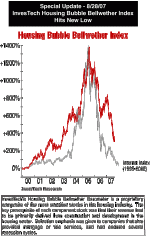
hb.gif

How about this update from my last post of this on 8/30/06. There's still plenty of downside possible.
 
Back
Top