

sharon sanders
Editor-in-Chief & President
May 14, 2025
About Traveler-based Genomic Surveillance
At a glance
U.S. airports are visited by more than 1 billion travelers each year. Travelers move from place to place quickly and can spread pathogens across international borders, making them an important population to consider when monitoring for new and emerging communicable diseases.
Strategic biosurveillance at international airports can
Traveler-based Genomic Surveillance Data Biosurveillance at airports can help us detect and prevent the spread of communicable diseases.
How information is collected
View Larger
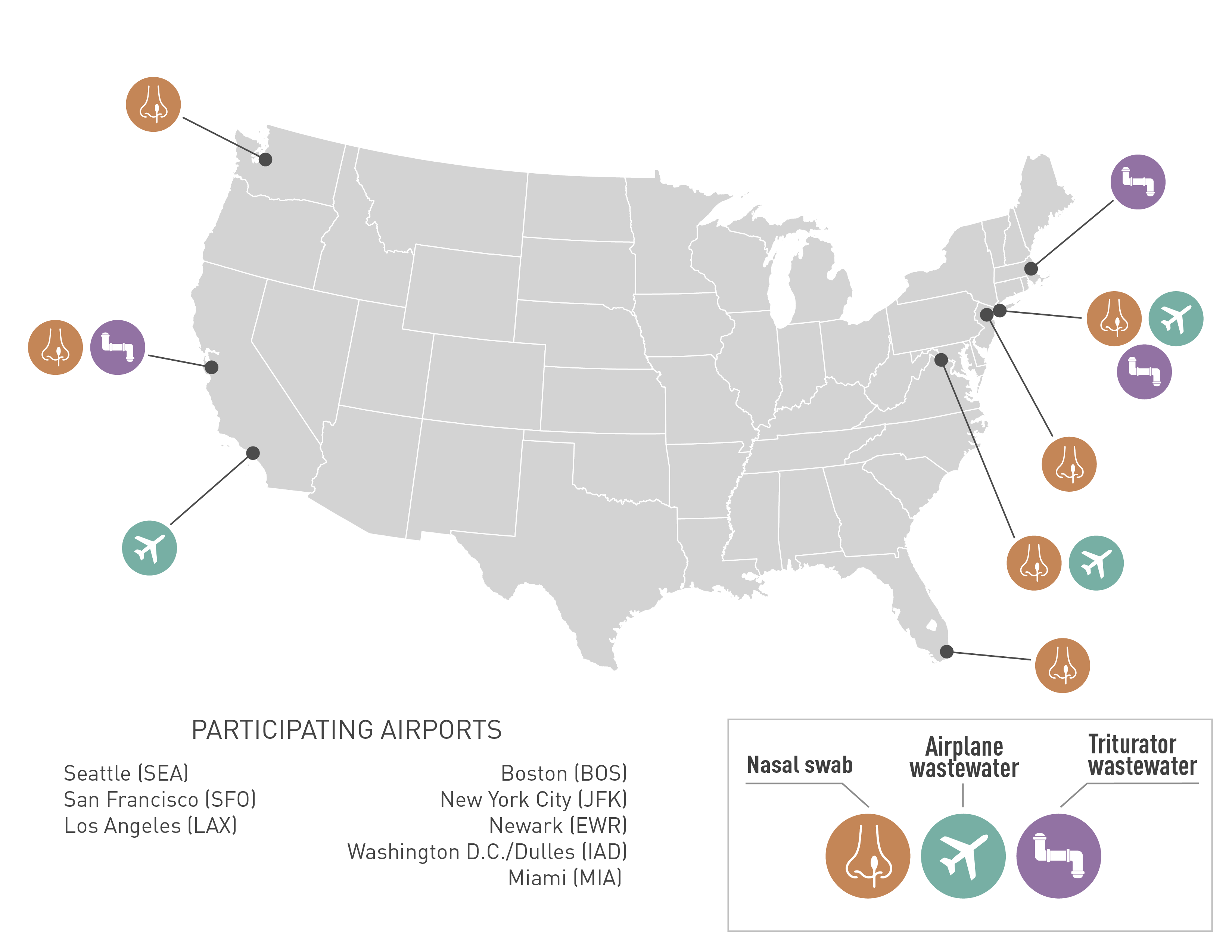 U.S. map of international airports participating in the TGS program, and the type of sampling conducted at each
Nasal swab samples
Nasal swab samples collected from arriving international travelers provide data for detecting pathogens of public health concern that are circulating globally. All traveler samples are collected voluntarily, and participation is anonymous.
The process
Wastewater from airplanes can be tested to detect traces of pathogens shed when infected travelers use the bathroom or wash their hands while onboard an airplane. Monitoring wastewater from international flights is an effective tool to track pathogens that are circulating globally, before they spread into communities.
The process
 Wastewater collected from airplanes can help us detect diseases before they spread more widely.
Reports, datasets, and publications
Travel Health Public Inquiries (CDC) travelhealthpi@cdc.gov On This Page
Related Pages
View AllTraveler-based Genomic Surveillance
Maps, Charts, and Data
Sources
https://www.cdc.gov/traveler-genomic-surveillance/about/index.html
About Traveler-based Genomic Surveillance
At a glance
- The Traveler-based Genomic Surveillance program (TGS) is a public-private partnership that monitors for communicable diseases among arriving international travelers at select U.S. airports.
- The program focuses on early detection of communicable diseases of public health concern, including viruses like influenza A, influenza B, RSV, and SARS-CoV-2 (the virus that causes COVID-19).
- The program also fills gaps in global biosurveillance by monitoring trends in global circulation of communicable diseases.
U.S. airports are visited by more than 1 billion travelers each year. Travelers move from place to place quickly and can spread pathogens across international borders, making them an important population to consider when monitoring for new and emerging communicable diseases.
Strategic biosurveillance at international airports can
- Enable timely detection of communicable diseases of public health concern,
- Limit the spread of communicable diseases to local communities, and
- Reduce the need for border interventions and disruptions to travel and trade.
Traveler-based Genomic Surveillance Data Biosurveillance at airports can help us detect and prevent the spread of communicable diseases.
How information is collected
View Larger
Nasal swab samples
Nasal swab samples collected from arriving international travelers provide data for detecting pathogens of public health concern that are circulating globally. All traveler samples are collected voluntarily, and participation is anonymous.
The process
- International travelers arriving at select airports volunteer to self-collect two nasal swab samples and complete a short survey. One sample is pooled with other travelers' samples.
- Individual and pooled samples are shipped to a laboratory. If pooled samples are positive by reverse transcription polymerase chain reaction (RT-PCR) for pathogens of public health concern, individual samples are tested.
- Individual samples positive for select pathogens undergo sequencing to determine variants, strains, or mutations of public health importance.
- Select positive individual samples are shared with CDC laboratories for further genomic characterization, which can provide information about a new variant's or strain's transmissibility, virulence, and response to current treatments or vaccines.
Wastewater from airplanes can be tested to detect traces of pathogens shed when infected travelers use the bathroom or wash their hands while onboard an airplane. Monitoring wastewater from international flights is an effective tool to track pathogens that are circulating globally, before they spread into communities.
The process
- Wastewater is collected in two ways:
- Wastewater from individual airplanes is collected using a custom-made collection device during routine servicing by a lavatory truck.
- Wastewater from multiple airplanes is collected from an airport triturator using an automated sampler. A triturator is a consolidation point where lavatory trucks deposit airplane wastewater. It does not include airport terminal waste.
- Wastewater samples are shipped to a laboratory for digital polymerase chain reaction (dPCR) testing for pathogens of public health concern.
- Samples positive for select pathogens undergo sequencing to determine variants, strains, or mutations of public health importance.
Reports, datasets, and publications
- Early Detection of Severe Acute Respiratory Syndrome Coronavirus 2 Variants Using Traveler-based Genomic Surveillance at 4 US Airports, September 2021-January 2022. Clinical Infectious Diseases. 2022 Jun 10. https://academic.oup.com/cid/advance-article/doi/10.1093/cid/ciac461/6605116?login=true
- Aircraft Wastewater Surveillance for Early Detection of SARS-CoV-2 Variants — John F. Kennedy International airport. MMWR, February 24, 2023; 72(8).
- Effect of Predeparture Testing on Postarrival SARS-CoV-2–Positive Test Results Among International Travelers — CDC Traveler-Based Genomic Surveillance Program, Four U.S. Airports, March–September 2022. MMWR, February 24, 2023; 72(8).
- Notes from the Field: Early Identification of the SARS-CoV-2 Omicron BA.2.86 Variant by the Traveler-Based Genomic Surveillance Program — Dulles International Airport, August 2023. MMWR, October 27, 2023; 72(43).
- SARS-CoV-2 Sample Positivity in Travellers Can Predict Community Prevalence Rates: Data from the Traveller-Based Genomic Surveillance Programme::SSRN
Travel Health Public Inquiries (CDC) travelhealthpi@cdc.gov On This Page
Related Pages
View AllTraveler-based Genomic Surveillance
Maps, Charts, and Data
Sources
https://www.cdc.gov/traveler-genomic-surveillance/about/index.html