

Michael Coston
Editor, Senior Moderator
Study: SARS-CoV-2 Infection and Viral Fusogens Cause Neuronal and Glial Fusion that Compromises Neuronal Activity
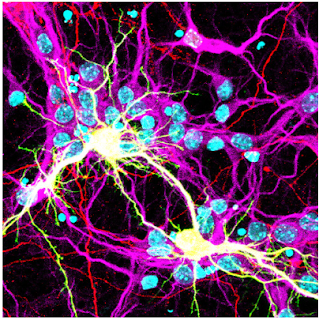
Image of fused neurons (yellow) expressing Spike S fusogen
from the SARS-CoV-2 virus and the human receptor hACE2.
#17,488
One of the most common, and long-lasting, complaints from those who have had COVID is `brain fog', which is also often reported by those diagnosed with ME/CFS. While accepted as part of the panoply of symptoms linked to `Long COVID', a plausible biological mechanism that would explain this cognitive deficit has been elusive.
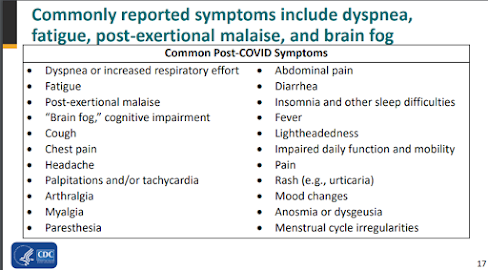
Slide From June 17th, 2021 CDC COCA Call on `Post-COVID' Syndrome
Today we've got a detailed research article published in the Journal Science Advances and a press release from Queensland University's Brain Institute, which shed new light on the impact of COVID infection on the brain.
First stop, a brief summary from the Queensland Brain Institute.
Researchers at The University of Queensland have discovered viruses such as SARS-CoV-2 can cause brain cells to fuse, initiating malfunctions that lead to chronic neurological symptoms.
Professor Massimo Hilliard and Dr Ramon Martinez-Marmol from the Queensland Brain Institute have explored how viruses alter the function of the nervous system.
SARS-CoV-2, the virus that causes COVID-19, has been detected in the brains of people with ‘long COVID’ months after their initial infection.
“We discovered COVID-19 causes neurons to undergo a cell fusion process, which has not been seen before,” Professor Hilliard said.
“After neuronal infection with SARS-CoV-2, the spike S protein becomes present in neurons, and once neurons fuse, they don’t die.”
“They either start firing synchronously, or they stop functioning altogether.”
As an analogy, Professor Hilliard likened the role of neurons to that of wires connecting switches to the lights in a kitchen and a bathroom.
“Once fusion takes place, each switch either turns on both the kitchen and bathroom lights at the same time, or neither of them,” he said.
“It’s bad news for the two independent circuits.”
The discovery offers a potential explanation for persistent neurological effects after a viral infection.
“In the current understanding of what happens when a virus enters the brain, there are two outcomes – either cell death or inflammation,” Dr Martinez-Marmol said.
“But we’ve shown a third possible outcome, which is neuronal fusion.”
Dr Martinez-Marmol said numerous viruses cause cell fusion in other tissues, but also infect the nervous system and could be causing the same problem there.
“These viruses include HIV, rabies, Japanese encephalitis, measles, herpes simplex virus and Zika virus,” he said.
“Our research reveals a new mechanism for the neurological events that happen during a viral infection.
“This is potentially a major cause of neurological diseases and clinical symptoms that is still unexplored.”
The researchers acknowledge the collaborative efforts of Professor Lars Ittner and Associate Professor Yazi Ke from Macquarie University, Associate Professor Giuseppe Balistreri from University of Helsinki and Associate Professor Kirsty Short and Professor Frederic Meunier from The University of Queensland.
Due to its length, and technical nature, I've only posted the link and abstract of the study below. Follow the link to read it in its entirety. I'll have a brief postscript after you return.
SARS-CoV-2 infection and viral fusogens cause neuronal and glial fusion that compromises neuronal activity
RAMÓN MARTÍNEZ-MÁRMOL , ROSINA GIORDANO-SANTINI, EVA KAULICH , ANN-NA CHO , MAGDALENA PRZYBYLA , MD ASRAFUZZAMAN RIYADH , EMILIJA ROBINSON, KENG YIH CHEW, RUMELO AMOR, [...], AND MASSIMO A. HILLIARD +5 authors Authors Info & Affiliations
We demonstrate that neuronal fusion is a progressive event, leads to the formation of multicellular syncytia, and causes the spread of large molecules and organelles. Last, using Ca2+ imaging, we show that fusion severely compromises neuronal activity. These results provide mechanistic insights into how SARS-CoV-2 and other viruses affect the nervous system, alter its function, and cause neuropathology
(Continue . . . )
For economic, societal, and political reasons society has decided that COVID should be treated as a `mild, almost trivial flu-like' illness. Vaccine uptake has plummeted over the past year - as has the use of face masks in public - and most countries no longer report cases, hospitalizations, or deaths.
While the vast majority of people survive (99%+) survive the acute phase of the infection, somewhere between 10% and 30% of survivors report some degree of `Long COVID' symptoms.
Many eventually recover, but for some, it can become a permanent disability.
Next week the CDC will hold a COCA Call webinar for clinicians on Evaluating and Supporting Patients with Long COVID in Returning to Work, and we've seen a number of studies suggesting that with each reinfection, the risks of complications or developing Long COVID increase.
There are some doctors who worry that we may see a rise in neurodegenerative diseases as a result of the COVID pandemic (see Review Article: Parkinsonism as a Third Wave of the COVID-19 Pandemic? and Neuron: Virus Exposure and Neurodegenerative Disease Risk Across National Biobanks).
It may take years before we know if some of these more dire concerns are valid, but the results of today's report should be enough to give one pause. Between vaccines, some semblance of community immunity, and the emergence of a `milder' Omicron lineage, COVID may not be the killer it once was.
But it is still far from benign.
https://afludiary.blogspot.com/2023/06/study-sars-cov-2-infection-and-viral.html
Image of fused neurons (yellow) expressing Spike S fusogen
from the SARS-CoV-2 virus and the human receptor hACE2.
#17,488
One of the most common, and long-lasting, complaints from those who have had COVID is `brain fog', which is also often reported by those diagnosed with ME/CFS. While accepted as part of the panoply of symptoms linked to `Long COVID', a plausible biological mechanism that would explain this cognitive deficit has been elusive.
Slide From June 17th, 2021 CDC COCA Call on `Post-COVID' Syndrome
Today we've got a detailed research article published in the Journal Science Advances and a press release from Queensland University's Brain Institute, which shed new light on the impact of COVID infection on the brain.
First stop, a brief summary from the Queensland Brain Institute.
8 Jun 2023
Researchers at The University of Queensland have discovered viruses such as SARS-CoV-2 can cause brain cells to fuse, initiating malfunctions that lead to chronic neurological symptoms.
Professor Massimo Hilliard and Dr Ramon Martinez-Marmol from the Queensland Brain Institute have explored how viruses alter the function of the nervous system.
SARS-CoV-2, the virus that causes COVID-19, has been detected in the brains of people with ‘long COVID’ months after their initial infection.
“We discovered COVID-19 causes neurons to undergo a cell fusion process, which has not been seen before,” Professor Hilliard said.
“After neuronal infection with SARS-CoV-2, the spike S protein becomes present in neurons, and once neurons fuse, they don’t die.”
“They either start firing synchronously, or they stop functioning altogether.”
As an analogy, Professor Hilliard likened the role of neurons to that of wires connecting switches to the lights in a kitchen and a bathroom.
“Once fusion takes place, each switch either turns on both the kitchen and bathroom lights at the same time, or neither of them,” he said.
“It’s bad news for the two independent circuits.”
The discovery offers a potential explanation for persistent neurological effects after a viral infection.
“In the current understanding of what happens when a virus enters the brain, there are two outcomes – either cell death or inflammation,” Dr Martinez-Marmol said.
“But we’ve shown a third possible outcome, which is neuronal fusion.”
Dr Martinez-Marmol said numerous viruses cause cell fusion in other tissues, but also infect the nervous system and could be causing the same problem there.
“These viruses include HIV, rabies, Japanese encephalitis, measles, herpes simplex virus and Zika virus,” he said.
“Our research reveals a new mechanism for the neurological events that happen during a viral infection.
“This is potentially a major cause of neurological diseases and clinical symptoms that is still unexplored.”
The researchers acknowledge the collaborative efforts of Professor Lars Ittner and Associate Professor Yazi Ke from Macquarie University, Associate Professor Giuseppe Balistreri from University of Helsinki and Associate Professor Kirsty Short and Professor Frederic Meunier from The University of Queensland.
Due to its length, and technical nature, I've only posted the link and abstract of the study below. Follow the link to read it in its entirety. I'll have a brief postscript after you return.
SARS-CoV-2 infection and viral fusogens cause neuronal and glial fusion that compromises neuronal activity
RAMÓN MARTÍNEZ-MÁRMOL , ROSINA GIORDANO-SANTINI, EVA KAULICH , ANN-NA CHO , MAGDALENA PRZYBYLA , MD ASRAFUZZAMAN RIYADH , EMILIJA ROBINSON, KENG YIH CHEW, RUMELO AMOR, [...], AND MASSIMO A. HILLIARD +5 authors Authors Info & Affiliations
Abstract
Numerous viruses use specialized surface molecules called fusogens to enter host cells. Many of these viruses, including the severe acute respiratory syndrome coronavirus 2 (SARS-CoV-2), can infect the brain and are associated with severe neurological symptoms through poorly understood mechanisms. We show that SARS-CoV-2 infection induces fusion between neurons and between neurons and glia in mouse and human brain organoids. We reveal that this is caused by the viral fusogen, as it is fully mimicked by the expression of the SARS-CoV-2 spike (S) protein or the unrelated fusogen p15 from the baboon orthoreovirus.
Numerous viruses use specialized surface molecules called fusogens to enter host cells. Many of these viruses, including the severe acute respiratory syndrome coronavirus 2 (SARS-CoV-2), can infect the brain and are associated with severe neurological symptoms through poorly understood mechanisms. We show that SARS-CoV-2 infection induces fusion between neurons and between neurons and glia in mouse and human brain organoids. We reveal that this is caused by the viral fusogen, as it is fully mimicked by the expression of the SARS-CoV-2 spike (S) protein or the unrelated fusogen p15 from the baboon orthoreovirus.
We demonstrate that neuronal fusion is a progressive event, leads to the formation of multicellular syncytia, and causes the spread of large molecules and organelles. Last, using Ca2+ imaging, we show that fusion severely compromises neuronal activity. These results provide mechanistic insights into how SARS-CoV-2 and other viruses affect the nervous system, alter its function, and cause neuropathology
(Continue . . . )
For economic, societal, and political reasons society has decided that COVID should be treated as a `mild, almost trivial flu-like' illness. Vaccine uptake has plummeted over the past year - as has the use of face masks in public - and most countries no longer report cases, hospitalizations, or deaths.
While the vast majority of people survive (99%+) survive the acute phase of the infection, somewhere between 10% and 30% of survivors report some degree of `Long COVID' symptoms.
Many eventually recover, but for some, it can become a permanent disability.
Next week the CDC will hold a COCA Call webinar for clinicians on Evaluating and Supporting Patients with Long COVID in Returning to Work, and we've seen a number of studies suggesting that with each reinfection, the risks of complications or developing Long COVID increase.
There are some doctors who worry that we may see a rise in neurodegenerative diseases as a result of the COVID pandemic (see Review Article: Parkinsonism as a Third Wave of the COVID-19 Pandemic? and Neuron: Virus Exposure and Neurodegenerative Disease Risk Across National Biobanks).
It may take years before we know if some of these more dire concerns are valid, but the results of today's report should be enough to give one pause. Between vaccines, some semblance of community immunity, and the emergence of a `milder' Omicron lineage, COVID may not be the killer it once was.
But it is still far from benign.
https://afludiary.blogspot.com/2023/06/study-sars-cov-2-infection-and-viral.html