

Michael Coston
Editor, Senior Moderator
CDC FluView Reports Another Novel Swine Variant (H1N2v) Infection
#17,025
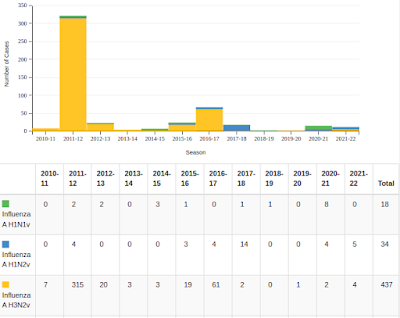
Prior to the 2017-18 flu season, H3N2v viruses made up more than 90% of all human swine variants reported in the United States (since 2010). H1N1v and H1N2v each accounted for less than 3% of all known cases.
Since 2017-18, however, H1N2v has become the dominant strain reported (n=23), outpacing H3N2v by more than 2 to 1.
That said, the number of H1N2v infections being reported these past few years pales in comparison to some of the banner years (2012 with 315, and 2016-17 with 61) H3N2v infections. Most swine variant infections likely go unreported, however, since most people are never tested for mild or even moderate flu-like illnesses.
Today's FluView Week 37 provides the following brief report on the 5th H1N2v infection of this summer.
A total of eight human infections with variant novel influenza A viruses have been reported in the United States in 2022, including three H3N2v (West Virginia) and five H1N2v (Georgia, Michigan, Ohio, Oregon, Wisconsin) viruses. When an influenza virus that normally circulates in swine (but not people) is detected in a person, it is called a “variant influenza virus.” Most human infections with variant influenza viruses occur following exposure to swine, but human-to-human transmission can occur. It is important to note that in most cases, variant influenza viruses have not shown the ability to spread easily and sustainably from person to person.
Additional information on influenza in swine, variant influenza virus infection in humans, and guidance to interact safely with swine can be found at www.cdc.gov/flu/swineflu/index.htm.
Although it is rare to see swine variant viruses spread efficiently in humans, and most cases are mild or moderate, the CDC's IRAT (Influenza Risk Assessment Tool) lists 3 North American swine viruses as having at least somepandemic potential (2 added in 2019).
H1N2 variant [A/California/62/2018] Jul 2019 5.8 5.7 Moderate
H3N2 variant [A/Ohio/13/2017] Jul 2019 6.6 5.8 Moderate
The pandemic risk from swine variant viruses is low, but not zero, as these viruses continue to reinvent themselves as they circulate in pigs.
For more on this summer's swine variant uptick, you may wish to revisit:
https://afludiary.blogspot.com/2022/09/cdc-fluview-reports-another-novel-swine.html
#17,025
Prior to the 2017-18 flu season, H3N2v viruses made up more than 90% of all human swine variants reported in the United States (since 2010). H1N1v and H1N2v each accounted for less than 3% of all known cases.
Since 2017-18, however, H1N2v has become the dominant strain reported (n=23), outpacing H3N2v by more than 2 to 1.
That said, the number of H1N2v infections being reported these past few years pales in comparison to some of the banner years (2012 with 315, and 2016-17 with 61) H3N2v infections. Most swine variant infections likely go unreported, however, since most people are never tested for mild or even moderate flu-like illnesses.
Today's FluView Week 37 provides the following brief report on the 5th H1N2v infection of this summer.
A human infection with a novel influenza A virus was reported by the Georgia Department of Public Health. The patient was infected with an influenza A(H1N2) variant (A(H1N2)v) virus. The patient is <18 years of age, was not hospitalized, and has recovered from their illness. An investigation by local public health officials found that the patient had swine contact and had attended agricultural fairs prior to their illness onset. Additional investigation did not identify respiratory illness in any of the patient’s household contacts. No person-to-person transmission of A(H1N2)v virus associated with this patient has been identified.
A total of eight human infections with variant novel influenza A viruses have been reported in the United States in 2022, including three H3N2v (West Virginia) and five H1N2v (Georgia, Michigan, Ohio, Oregon, Wisconsin) viruses. When an influenza virus that normally circulates in swine (but not people) is detected in a person, it is called a “variant influenza virus.” Most human infections with variant influenza viruses occur following exposure to swine, but human-to-human transmission can occur. It is important to note that in most cases, variant influenza viruses have not shown the ability to spread easily and sustainably from person to person.
Early identification and investigation of human infections with novel influenza A viruses are critical so that the risk of infection can be understood, and appropriate public health measures can be taken.
Additional information on influenza in swine, variant influenza virus infection in humans, and guidance to interact safely with swine can be found at www.cdc.gov/flu/swineflu/index.htm.
Additional information regarding human infections with novel influenza A viruses can be found at http://gis.cdc.gov/grasp/fluview/Novel_Influenza.html.
Although it is rare to see swine variant viruses spread efficiently in humans, and most cases are mild or moderate, the CDC's IRAT (Influenza Risk Assessment Tool) lists 3 North American swine viruses as having at least somepandemic potential (2 added in 2019).
H1N2 variant [A/California/62/2018] Jul 2019 5.8 5.7 Moderate
H3N2 variant [A/Ohio/13/2017] Jul 2019 6.6 5.8 Moderate
H3N2 variant [A/Indiana/08/2011] Dec 2012 6.0 4.5 Moderate
The pandemic risk from swine variant viruses is low, but not zero, as these viruses continue to reinvent themselves as they circulate in pigs.
For more on this summer's swine variant uptick, you may wish to revisit:
https://afludiary.blogspot.com/2022/09/cdc-fluview-reports-another-novel-swine.html